
Exclusive
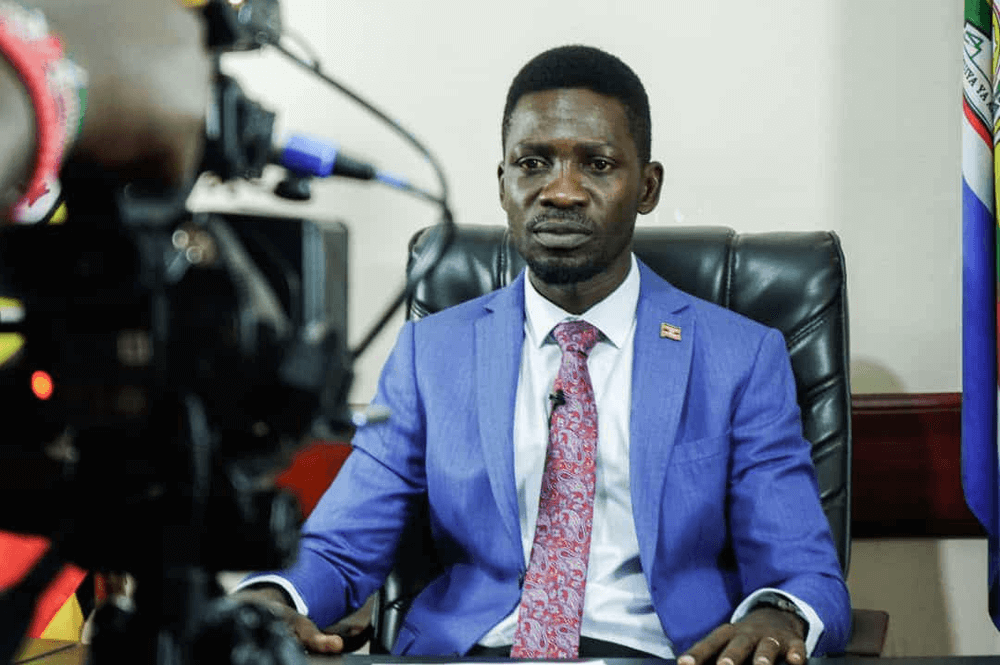
H.E. Bobiwine END OF YEAR MESSAGE

H.E. Bobiwine END OF YEAR MESSAGE

Fellow countrymen and women,
I bring you warm greetings wherever you are and congratulate you upon coming to and end of this year, which has been a very difficult one for many Ugandans.
I thank God for the gift of life. It is not something to take for granted, that those of us who are alive today have that opportunity.
I send deepest condolences and sympathies to all Ugandans who have lost loved ones this year and pray that those who are sick will have a quick and full recovery.
As we come to the end of the year, my message will focus on three issues:
1. A MESSAGE OF GRATITUDE
Let me take this opportunity to send deep gratitude to all Ugandans who continue to support the struggle against the dictatorship.
As we all know, at the start of the year, we had a presidential election, which General Museveni chose to turn into a military operation. Ugandans were murdered, tortured, abducted and others detained. As I write this, we still have hundreds of our people in different prisons across the country including Members of Parliament Muhammad Ssegirinya and Allan Ssewanyana. Ordinary Ugandans such as Olivia Lutaaya, Kassim Mugadde, Machete Yasin, and many others are under illegal detention and there is no sign of getting a free and fair trial. Comrades Nubian Li, Eddie Mutwe, Dan Magic and many others spent more than half of this year in prison. There are several other comrades who have lost limbs in this cause, while many others have paid the ultimate price.
I want to salute EVERYONE who has made any form of sacrifice in order to advance the struggle for a better country
Our brothers and sisters in the diaspora, I THANK YOU. Thank you for knocking on doors, speaking out, organising demonstrations, reporting those who abuse human rights to relevant organs and organisations, and supporting the struggle with logistics.
Thank you all for the tireless efforts. Even after Dictator Museveni grabbed our victory, many of you could have felt discouraged. But I am thankful to all of you who have not given up.
I want to thank, in a special way, all non-Ugandans who continue to support our struggle in different ways. The nations which are beginning to act against Museveni and his henchmen, the artistes who have been raising voices against human rights abuses in Uganda, the international media which has continued to shine a light on the injustices, and all those who have contributed in one way or another, THANK YOU.
I thank the millions of people in Uganda and abroad who send us prayers and messages of encouragement. THANK YOU
2. THE BALANCE OF FORCES
Many people might be wondering how the struggle against dictatorship in Uganda stands.
Let me use this message to once again affirm to all our people that the balance of forces is in the favor of the people of Uganda. All dictators, past and present follow the same path. Yes, Museveni grabbed the victory of Ugandans and has continued to misrule us through the barrel of the gun. But he is not as strong as he used to be. He is not as insulated as he used to be. And he is definitely much more vulnerable than he has ever been.
Our greatest achievement so far, has been stripping him naked. The whole world now knows that Uganda is ruled by a military tyrant who has no legitimate support of the people. This is an important achievement in any struggle to remove a dictatorship.
Secondly, the people of Uganda are now more awakened than ever. I pride in seeing Ugandans, young and old much more interested in the affairs of our country.
Fighting an entrenched dictatorship is not and has never been easy anywhere. When we spoke of #Mission2021 we were alive to these realities. I thank everyone who has contributed to the achievements registered this year. We may not have gotten our ultimate goal yet, but I want to assure everyone that we are on the right trajectory. If each one of us makes a commitment to do twice as much as we have done this year in this effort, we shall all be amazed at what we shall achieve. I say all this, well knowing that God is on our side.
3. A RESPONSE ON UNITY
After the Kayunga by-election fraud, I read with dismay several comments on social media about some issues. While most are sponsored or posted by people with a clearly destructive agenda, others are posted by people with genuine intentions, but who clearly do not have the full picture.
Some people made it a point to accuse the National Unity Platform of going alone in the Kayunga by-election, arguing that perhaps if we were united we would be declared winners.
First of all, WE WON THE ELECTION in Kayunga. We won it by a landslide- a clear 15000 vote lead. We deployed agents and supervisors, most of whom were arrested before the regime usurped the will of the people. There has been rigging in very many elections, but what they did in Kayunga was a new record. An election where you have all DR forms giving you a 15000 lead and the Returning Officer aided by Byabakama announces a different winner.
This is what everyone who claims to struggle for democracy should focus on. How do we get our nation from this mess?
Away from that, I wish to remind all Ugandans that the People Power Movement/ National Unity Platform has championed the unity of the forces of change right from inception. After the 2017 by-election in Kyadondo East that brought me to Parliament, I set out to meet with all leaders of political parties, Civil Society Organisations, religious institutions, etc. When we formed the People Power Movement, we brought together Ugandans from all shades of opinion. This is because in principle we believe that all Ugandans (not just politicians) will need to come together and forge a way forward towards a #NewUganda.
The challenge has always been the dishonesty in some cases and inconsistency in other cases. Some actors have clearly placed personal interest ahead of the national interest. There are many lessons we have learnt in trying to forge this unity, most of which we do not make public, because giving certain details can easily lead to further mistrust and suspicion.
For about two years before the election, we sat in more than fifty meetings with leaders and comrades within different formations in the ‘opposition’. Our view was that we needed to tackle Museveni with a single, strong candidate so that we would then scatter our energies across the country in trying to guard the vote. I was even willing not to be the joint candidate, if an honest analysis had been made and it was established that we front someone else. The discussions went on and on and on.
Previously before we launched the National Unity Platform , some of the Party leaders kept telling us they needed to consult their party organs. Others told us they needed to first elect their party flag bearers, who would then sit with us to agree on a joint candidate. Others claimed that they could not work with us because we were just a mere pressure group and not a registered political party.
It later became apparent that some of the actors were in fact not interested in our unity at all, but were using those meetings and engagements to derail and delay us. In fact, one of the last and most important meetings we had to discuss the question of unity took place at the home of Owek. Joyce Ssebugwaawo, now Museveni’s minister. It was later on that we established that all along she had been in touch with the regime, although she was a Deputy President of a major opposition party.
When we formed NUP and were taken to court, some of the people who worked very hard to see NUP de-registered were not NRM operatives, but some of our perceived comrades in other opposition formations. Some went as far as approaching the Electoral Commission and Court staff to beg that they influence our de-registration.
Some of these people were not necessarily working for the regime, but felt that if we had a political party, we would take over their space. You can imagine!
While we are busy fighting to see the regime down, some actors were very comfortable with their positions within the opposition!
By the time we went through the election and emerged out of it, we got credible information, (which is well within the knowledge of senior leaders), that Museveni sponsored several candidates at different levels in order to cut our speed.
As everyone can see, this is information that we normally get and decide to keep with ourselves, but I thought it is important to share it so that the people of Uganda understand the dynamics at play, and place the most trust in themselves. No one else will fight for them except themselves.
Of course not all actors within the forces of change have this negative attitude. There are very many decent, clear headed individuals whose objective is to see change in Uganda.
Immediately after the election, every Ugandan remembers that I personally wrote to all heads of political parties, in order for us to forge unity and take the struggle forward. Yet again, some actors responded positively, others responded negatively and others did not respond at all.
With all these setbacks, we have not given up on unity, but our view remains that the most important unity will have to come from the people of Uganda, and not just politicians. That is why we are the NATIONAL UNITY PLATFORM. Although we had many parties keen to have us take them over and lead them, our decision to take over NUP was consciously made because of our belief in National Unity.
Of course we continue to engage with all Ugandans, be it political leaders or not, on the urgent need to deliver our nation from the crisis which we face. This coming year, we must make a conscious decision to work together as comrades because the alternative would be to resign ourselves to a terrible fate.
In the coming year, each one of us should simply double his or her effort while trusting in God. Freedom is in sight.
Happy New Year to you all. God bless you.
Kyagulanyi Ssentamu Robert “Bobi Wine”


Revolutionary Articles
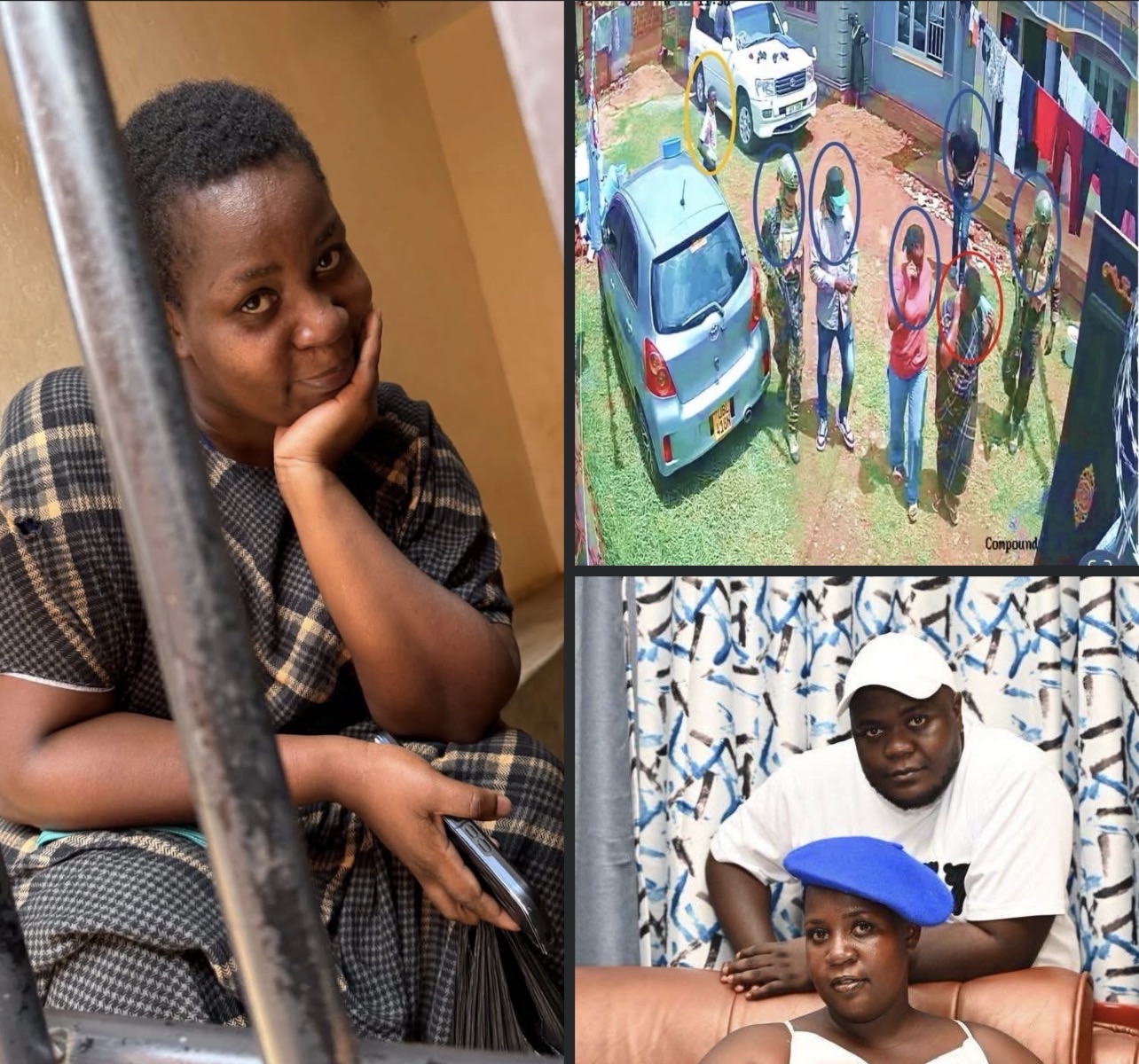
Abducted Wife of Bobiwine’s Personal Assistant dumped at Police, Immediately remanded to Prison.

Disappearance, Denial, and Control: What Uganda’s Abduction Pattern Really Means
In Uganda today, repression no longer hides in the shadows—it operates in plain sight.
The case of Natabi Fauzia, also known as Maama Kyeyunevu, is not an isolated incident. It is part of a deeply troubling and increasingly normalized pattern—one that reveals how power is exercised, how fear is manufactured, and how the rule of law is systematically undermined.
The Abduction in Plain Sight
On March 12th, security forces reportedly raided a residence linked to associates of Bobi Wine, following heightened political tension after disputed elections and earlier military operations in Magere.
The target was clear. Authorities were searching for Bobi Wine.
They found neither him nor his personal assistant.
Instead, they took Natabi Fauzia, the wife of his personal assistant, Don Sheriff.
There was no warrant publicly presented. No formal charges announced. No explanation given.
She was taken.
And then—she vanished.
Denial in the Face of Evidence
In the days and weeks that followed, her family, lawyers, and activists demanded answers.
- Habeas corpus applications were filed
- Court sessions convened
- Public pressure intensified
Yet, state authorities consistently denied having her in custody.
This denial persisted despite reports of CCTV footage showing uniformed personnel carrying out the operation.
This is not just silence. It is institutional denial in the face of visible reality.
The Reappearance: From “Missing” to “Accused”
Then, more than a month later, on April 17th, the narrative abruptly changed.
Natabi Fauzia was dumped at Kanyanya Police Station.
From there, events moved with striking speed:
- She was immediately processed
- Taken to court without access to lawyers or family
- Charged under unclear and questionable circumstances
- Remanded to Luzira Prison
In a matter of hours, a person who officially “did not exist in custody” became a formal criminal defendant.
What Is the State Communicating?
This pattern—abduction, denial, reappearance, prosecution—is not accidental. It is deliberate. And it communicates several powerful messages.
1. “We Are Above the Law”
When a person is taken, denied, and later produced, the message is unmistakable:
The law does not bind those in power.
Courts may sit. Lawyers may argue. But ultimately, the state decides when the law applies—and when it does not.
2. Fear as a Tool of Governance
This is psychological warfare.
It tells every activist, every supporter, every citizen:
- You can be taken at any time
- You can disappear without trace
- No institution will immediately save you
The uncertainty is the weapon.
Not knowing where someone is, or what is being done to them, creates deeper fear than open arrest ever could.
3. The Collapse of Judicial Authority
Habeas corpus—the legal principle meant to protect against unlawful detention—becomes meaningless when the state simply denies custody.
What does it mean when:
- Courts demand accountability
- The state responds with denial
- And reality later contradicts that denial
It means the judiciary is being openly undermined.
4. Breaking the Individual Before the Trial
A month in incommunicado detention is not neutral.
It is a period of:
- Isolation
- Interrogation
- Intimidation
- Possible coercion
By the time the victim appears in court, the process has already achieved its primary goal: control.
The trial becomes a formality.
5. Rewriting the Narrative
The transition is calculated:
- From “abducted victim”
- To “criminal suspect”
By reintroducing the individual through the police and courts, the state attempts to legitimize what was initially illegal.
It reshapes public perception:
Maybe it wasn’t an abduction. Maybe it was lawful all along.
This is narrative control in action.
6. Testing the Limits of Resistance
Each case is also an experiment:
- Will the public protest loudly—or fall silent?
- Will the legal community push back—or retreat?
- Will the international community respond—or ignore?
If there is no consequence, the practice continues—and expands.
A Pattern, Not an Exception
Natabi Fauzia’s case echoes the experiences of countless others in Uganda—activists, opposition supporters, and ordinary citizens caught in the machinery of state power.
This is no longer about isolated abuses.
It is about a system.
A system that:
- Removes individuals outside the law
- Holds them in secrecy
- Reintroduces them under legal cover
- And uses the entire process to instill fear and assert dominance
Conclusion: The Meaning Behind the Method
What is happening is not disorder.
It is organized repression disguised as procedure.
It sends a chilling message to the nation:
- Your freedom is conditional
- Your rights are negotiable
- Your voice can make you a target
And perhaps most importantly:
The state is not just enforcing power—it is performing it.
Ugandans are not strangers to laws introduced in the name of order and security—only for them to later restrict freedoms.
From the Public Order Management Act to sections of the Computer Misuse Act, history has shown a clear pattern: laws presented as protective tools have often been applied selectively—targeting opposition leaders, journalists, and ordinary citizens expressing dissent.
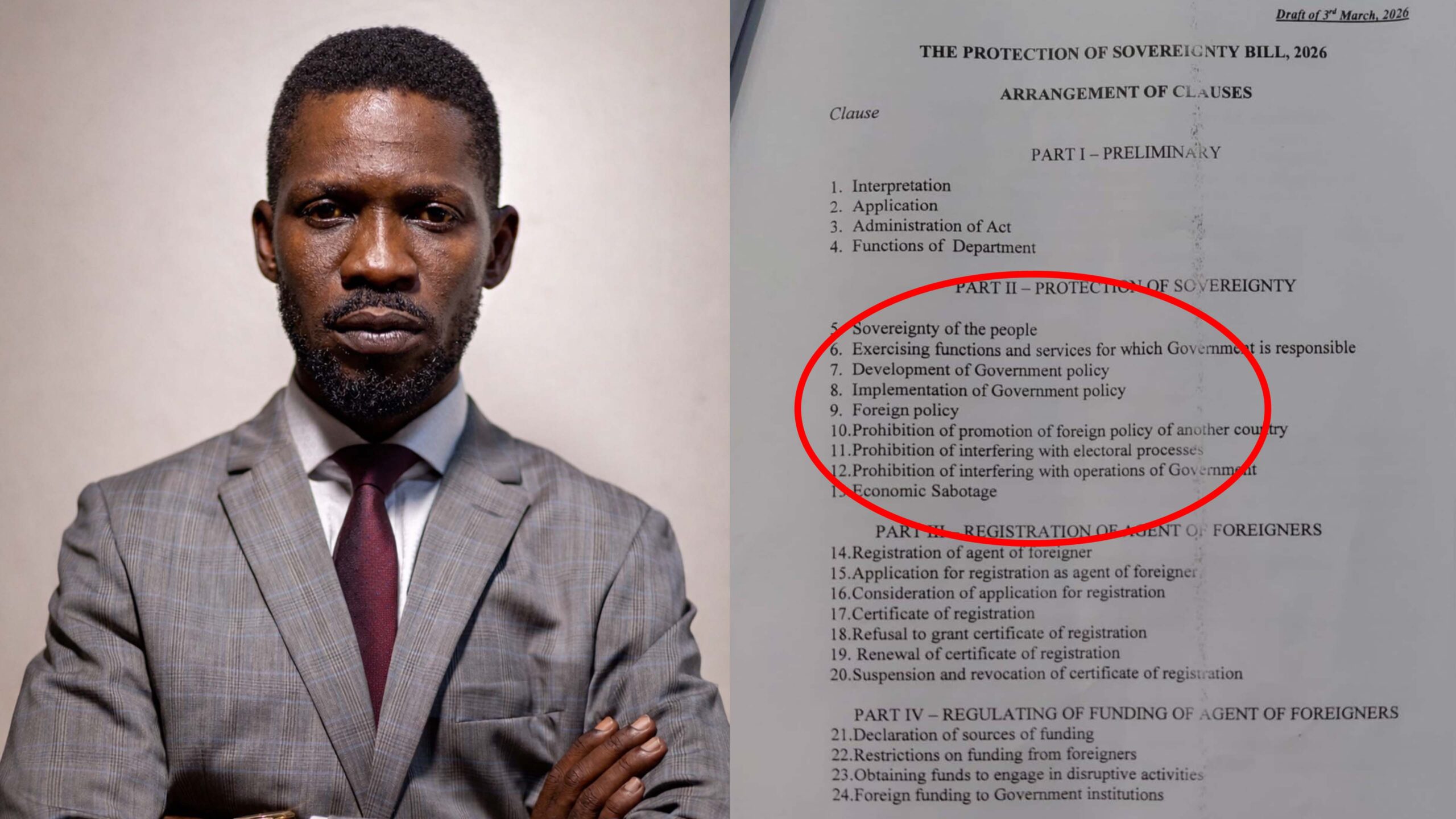
Now, the Protection of Sovereignty Bill, 2026 appears to follow that same path.
⚖️ The most dangerous laws don’t look dangerous
In politics, the most dangerous laws are rarely the ones that openly declare repression.
They are the ones that cloak control in the language of protection.
On paper, this bill promises to defend Uganda from foreign interference. It speaks of independence, dignity, and national control.
But beneath that language lies a deeper reality:
👉 Not a government protecting its people
👉 But a system protecting itself from its people
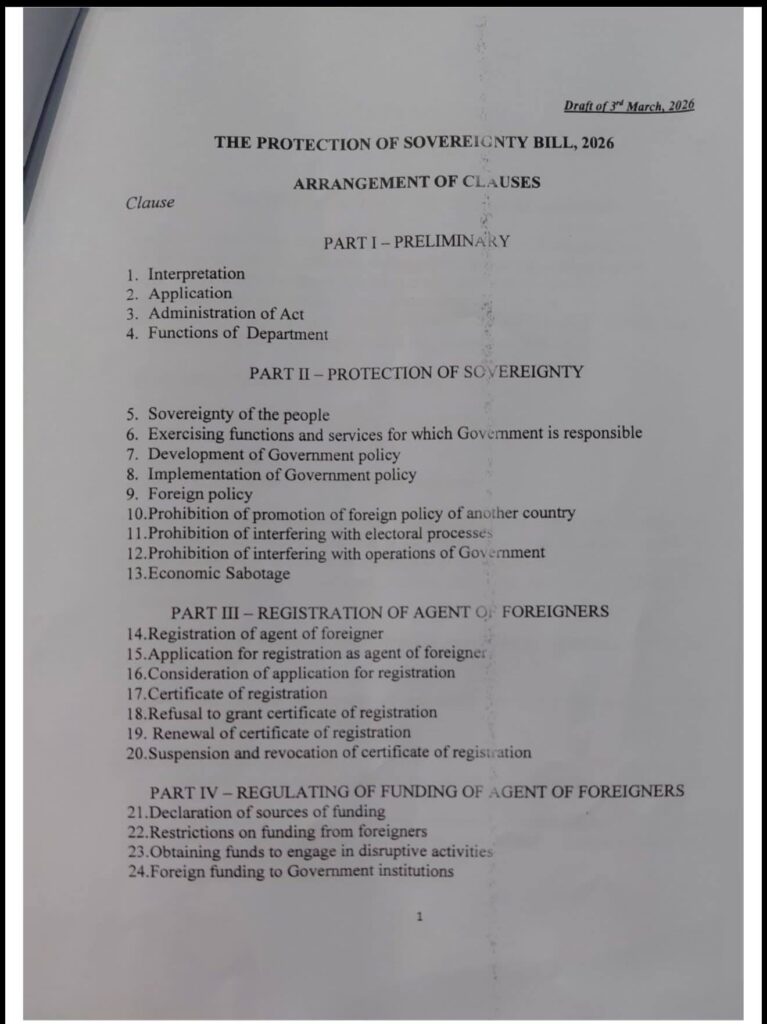
🔍 A quiet redefinition of sovereignty
Sovereignty, in its purest form, means power belongs to the citizens—it is the foundation of democracy.
But this bill subtly shifts that meaning.
Under its framework:
- Sovereignty becomes something the state must defend
- Not only from foreign actors
- But from any force that challenges authority
This shift is profound.
It blurs the line between:
- External interference
- Domestic dissent
👉 Criticism becomes destabilization
👉 Activism becomes foreign influence
And once that label is applied, suppression becomes not only justified—but legal.
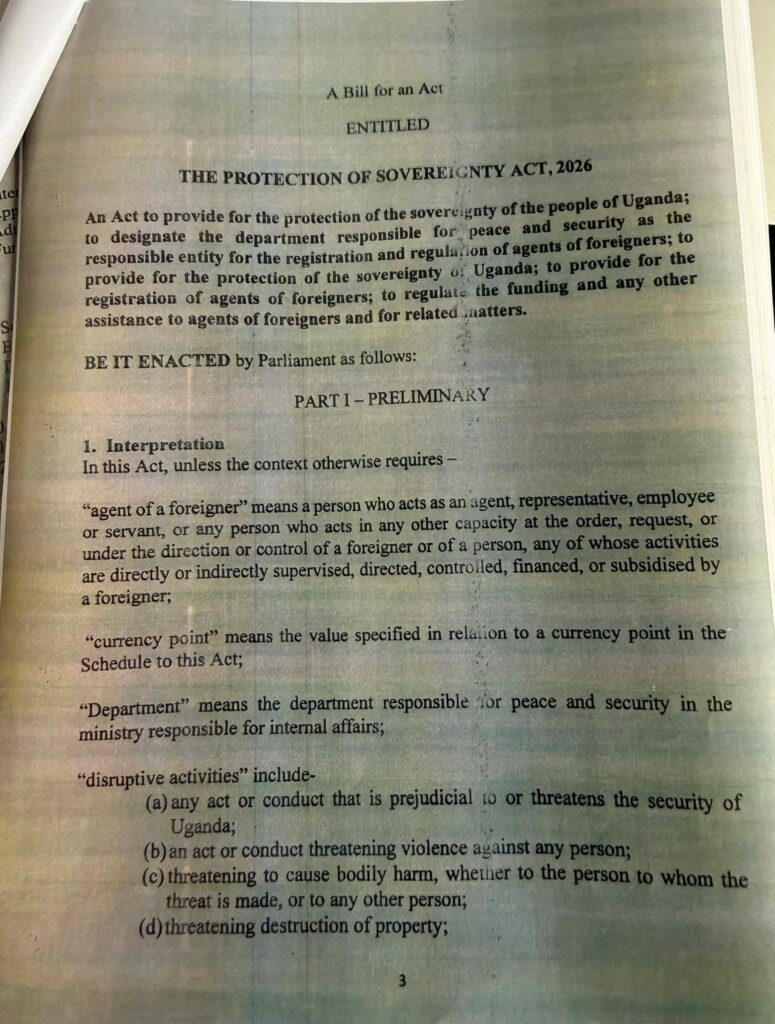
💰 The real target: the lifeline of resistance
Modern civic movements do not survive on ideas alone.
They rely on resources—funding, partnerships, and networks.
This is where the bill strikes with precision.
By:
- Requiring strict declaration of foreign funding
- Allowing monitoring and restriction of external support
- Granting the state power to block financial flows
👉 The law places the lifeline of civil society under control
It does not need to outlaw opposition.
It only needs to starve it.
Human rights organizations, independent media, and grassroots movements—many dependent on international support—could find themselves in a system where:
- Every transaction is suspect
- Every partnership is scrutinized
- Every initiative can be halted
This is not regulation.
👉 This is containment.
🔥 When activism becomes “foreign influence”
This is where the law directly intersects with Bobi Wine and the National Unity Platform.
For years, opposition movements and civic actors have:
- Engaged international media
- Spoken at global forums
- Met foreign policymakers
- Called for accountability and sanctions
- Partnered with international organizations
Under normal democratic practice, this is political advocacy.
But under this law, the same actions can be reframed as:
👉 Promoting foreign policy
👉 Receiving foreign assistance
👉 Influencing national processes
What has always been activism can now be redefined as criminal conduct.
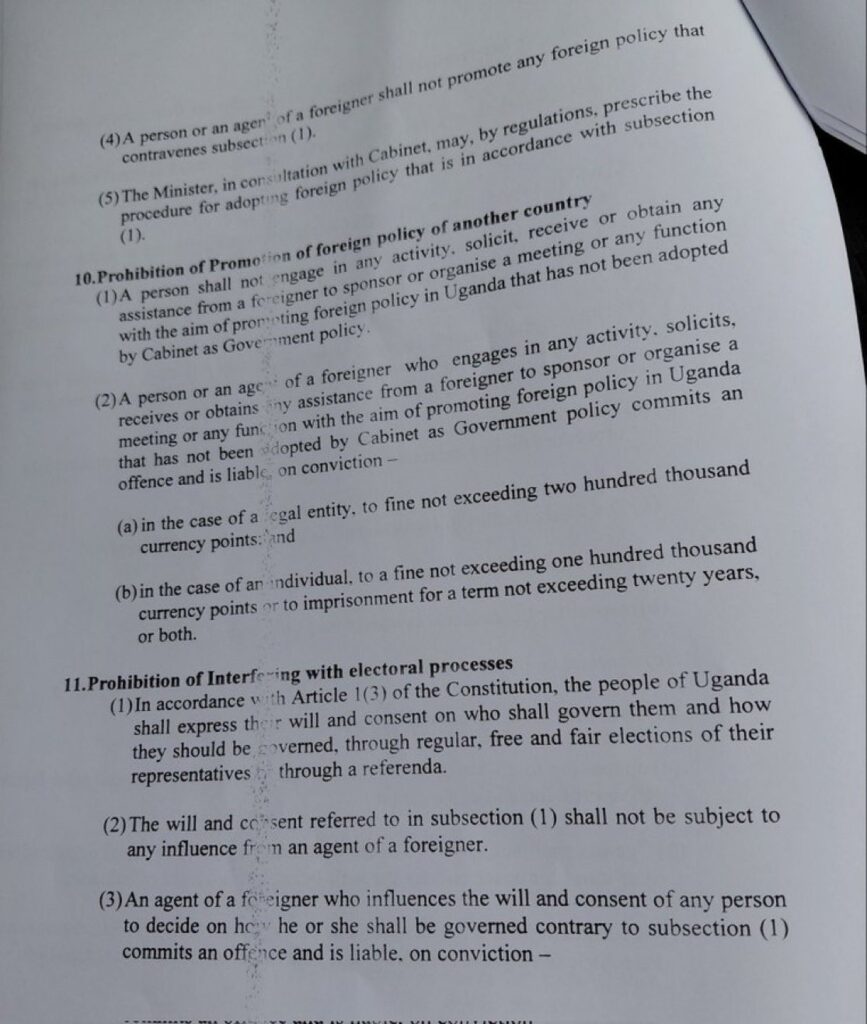
🌍 The diaspora: from contributors to suspects
Perhaps the most striking implication is its impact on Ugandans abroad.
For years, the diaspora has:
- Supported families through remittances
- Invested in development
- Advocated for governance and human rights
But under this law:
- Calling for accountability
- Supporting opposition efforts
- Engaging international partners
👉 could be interpreted as interference in national affairs
The consequences are severe:
- Up to 20 years imprisonment
- Massive financial penalties
These are not just punishments.
👉 They are deterrents—designed to silence.
🚨 The deeper risk: criminalizing dissent
The most serious implication is clear:
👉 Activities traditionally considered democratic engagement
can now be labeled as crimes.
This includes:
- Public criticism of government
- International advocacy
- Political organizing
Once framed as “foreign influence,” such actions carry severe penalties.
This is how dissent is not debated—
👉 but criminalized.
💰“Economic sabotage” — a dangerous expansion
The inclusion of “economic sabotage” introduces another powerful tool.
In a country where citizens increasingly demand transparency:
- Questioning public spending
- Exposing misuse of funds
- Demanding accountability
👉 could be interpreted as harming the economy
This flips accountability on its head:
👉 Scrutiny becomes a crime
👉 Silence becomes safety
⚡ A shift in narrative power
Beyond the legal implications, this bill reshapes political perception.
It enables a narrative where:
- Opposition = foreign-backed
- Criticism = external interference
- Activism = threat to sovereignty
And once that narrative is accepted:
👉 Enforcement becomes easy
👉 Suppression becomes justified
Final reflection: What kind of nation is being built?
Laws do more than regulate behavior—they define the character of a nation.
And this law sends a clear message:
- Speak carefully
- Associate cautiously
- Engage at your own risk
That is not the foundation of a confident democracy.
It is the posture of control.
👉 When criticism is redefined as foreign interference, and activism becomes a crime, the question is no longer about sovereignty—it is about freedom.
Revolutionary Articles
Bobi Wine’s Washington Engagement: Institutional Significance and Policy Implications
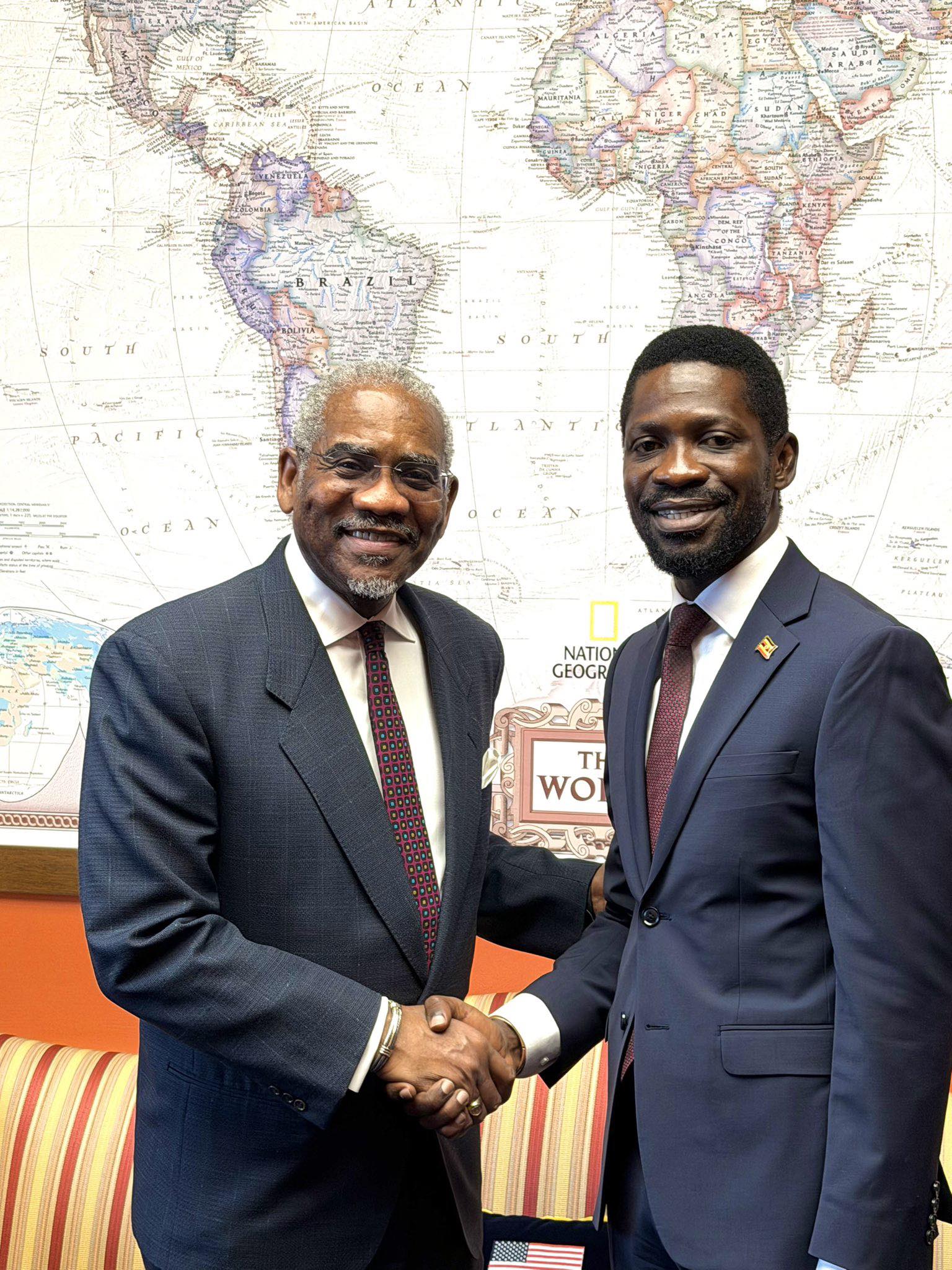
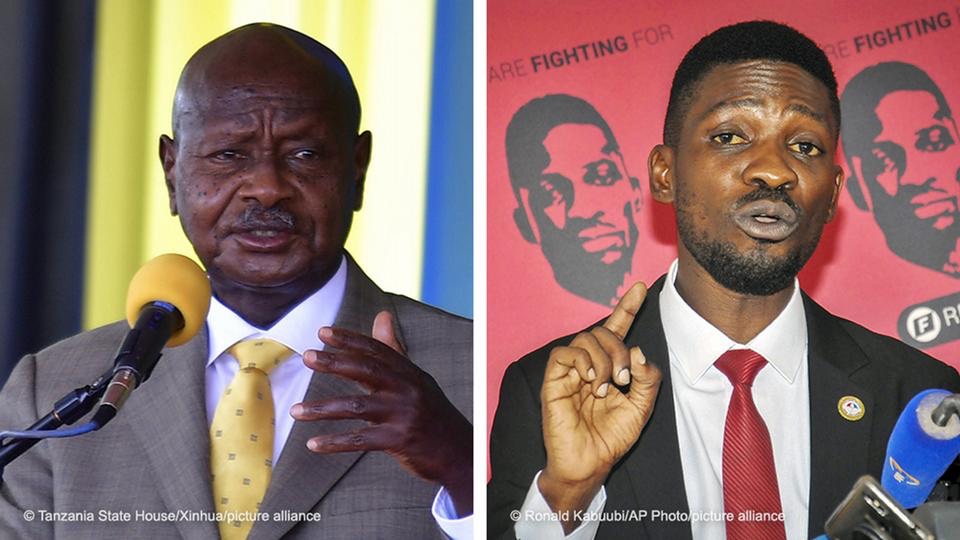
Ugandan opposition leader Bobi Wine who is currently in Washington onthe 28th of March 2026 held discussions with Gregory Meeks, a senior figure in the United States Congress who serves as Ranking Member of the House Foreign Affairs Committee and as a member of the House Committee on Financial Services. The engagement, which also referenced the Congressional Black Caucus, reflects a structured attempt to engage U.S. legislative institutions on governance, human rights, and accountability concerns in Uganda.
While opposition leaders frequently seek international audiences, the relevance of this meeting lies in the institutional weight of the offices involved and the policy mechanisms they influence.
Gregory Meeks: Legislative Influence in Foreign Policy and Finance
As Ranking Member of the House Foreign Affairs Committee, Gregory Meeks occupies a senior position within one of the most consequential committees in the U.S. Congress. The committee is responsible for oversight and legislation related to foreign policy, including diplomatic relations, foreign assistance, arms sales, and international agreements.
Although U.S. foreign policy is ultimately executed by the executive branch, Congress—through this committee—plays a significant role in shaping its direction. It can convene hearings, request briefings, and introduce legislation that conditions or restricts U.S. engagement with specific countries. In practice, this means that concerns raised at this level can enter formal policy discussions and influence how the United States frames its relationship with Uganda.
https://twitter.com/RepGregoryMeeks?s=20
In addition to his foreign policy role, Meeks serves on the House Committee on Financial Services. This committee oversees the U.S. financial system, including banking regulation, capital markets, and aspects of international finance. Of particular relevance is its indirect role in shaping sanctions frameworks and financial accountability measures. While sanctions are typically administered by the executive branch, Congress contributes to the legal and policy architecture that enables such actions, including legislation targeting corruption, illicit financial flows, and human rights abuses.
Taken together, these roles position Meeks at the intersection of diplomatic and financial levers—two of the primary tools through which the United States exerts influence internationally.
The House Foreign Affairs Committee: Scope and Function
The House Foreign Affairs Committee is central to the legislative branch’s engagement with global affairs. Its responsibilities include:
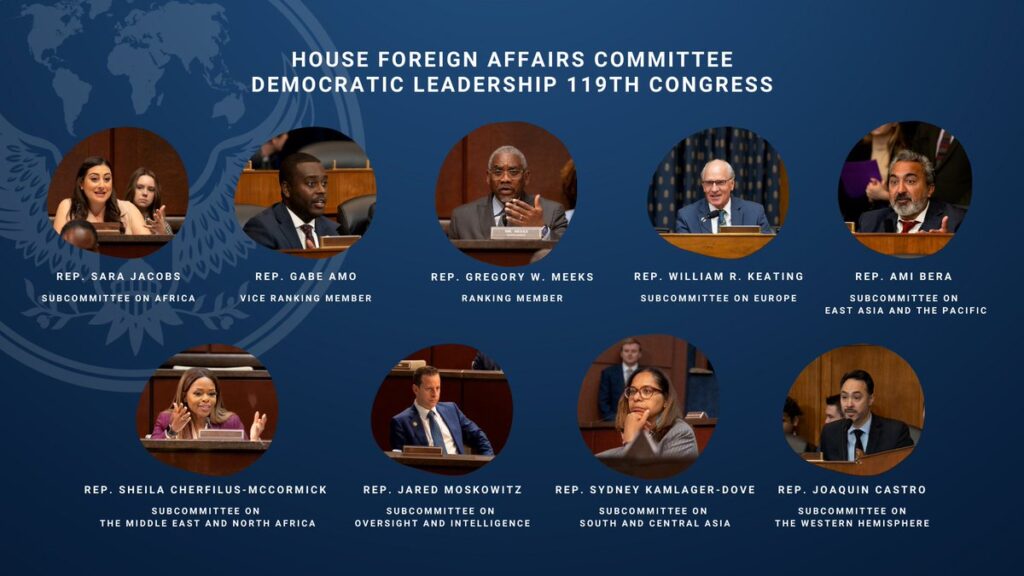
- Reviewing and shaping foreign aid allocations
- Overseeing U.S. diplomatic missions and international agreements
- Monitoring human rights conditions globally
- Evaluating security partnerships and military cooperation
Through hearings and reports, the committee can elevate specific country situations into the U.S. policy agenda. In cases where governance or human rights concerns are raised consistently, this can lead to increased scrutiny, formal recommendations, or legislative proposals affecting bilateral relations.
The House Committee on Financial Services: Financial Oversight and Accountability
The House Committee on Financial Services plays a distinct but complementary role. It is responsible for oversight of:
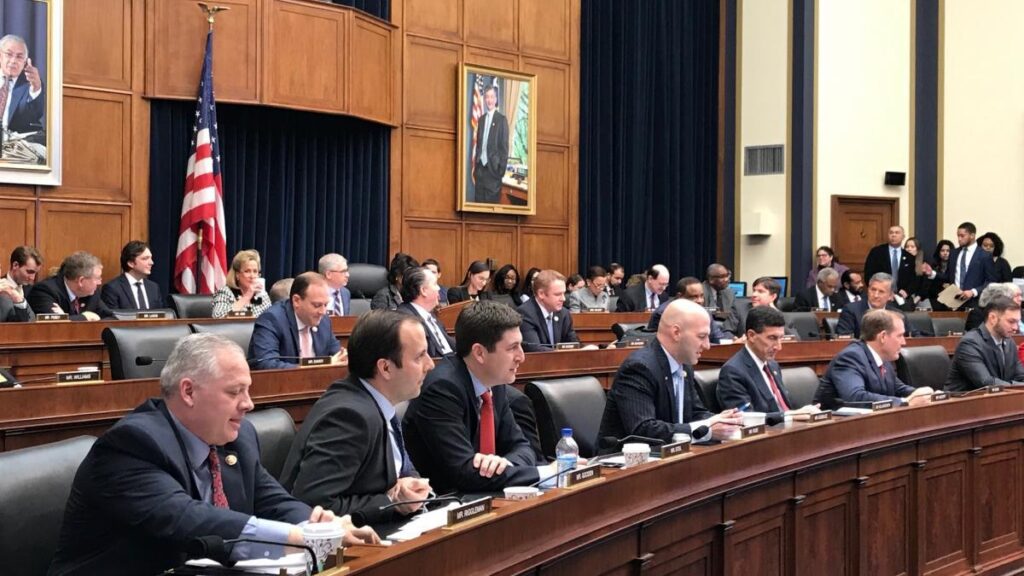
- The U.S. banking system and financial institutions
- International financial transactions and regulatory frameworks
- Anti-money laundering standards and enforcement mechanisms
- Financial sanctions architecture in coordination with other branches of government
While it does not directly impose sanctions, its legislative work can influence how financial tools are used to promote accountability. This includes shaping policies that affect access to international financial systems, particularly in cases involving corruption or human rights violations.
The Congressional Black Caucus
The Congressional Black Caucus is a coalition of African American members of the U.S. Congress. Established in 1971, it has historically played an active role in advocating for civil rights, social justice, and democratic governance, both domestically and internationally.
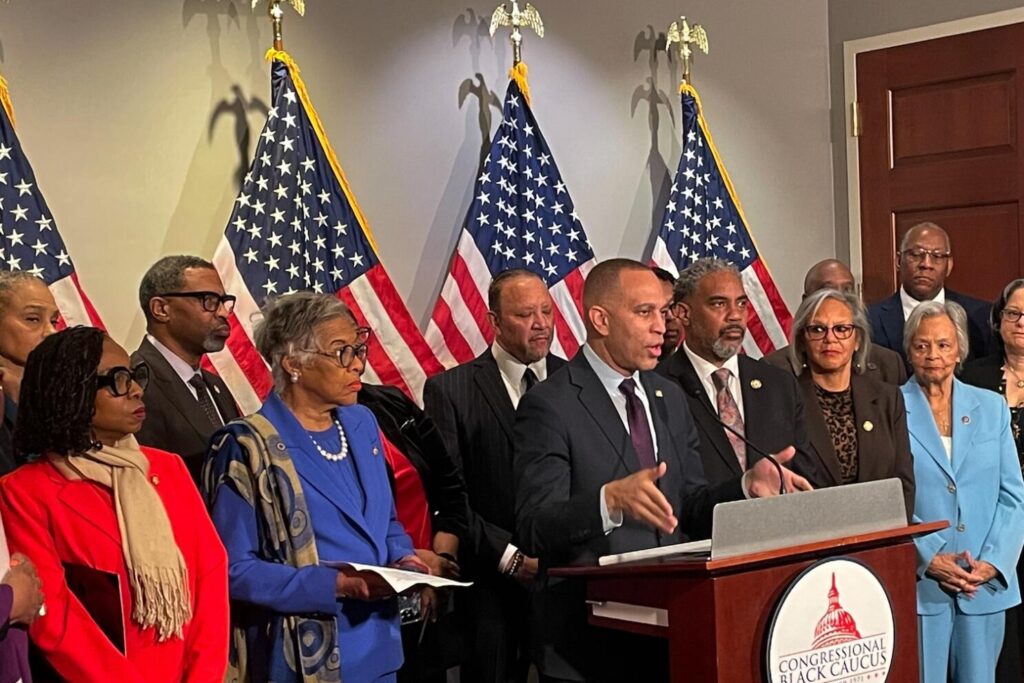
The CBC is one of the most organized and influential blocs in the Democratic Party.
In the context of Africa, the caucus has often taken positions on governance, electoral integrity, and human rights. While it does not exercise formal legislative authority as a committee, it carries political influence through advocacy, public statements, and its ability to shape discourse within Congress.
Its mention in this context suggests an effort to engage not only formal policy structures but also political networks that can amplify attention to specific issues.
Strategic Dimensions of the Bobiwine Engagement
Bobi Wine’s outreach can be understood as part of a broader strategy to engage external actors in addressing domestic political challenges. This approach reflects a recognition that international partnerships and pressure mechanisms can complement internal political processes.
One key dimension is narrative framing. By presenting Uganda’s situation in terms of governance and human rights, the engagement aligns with the criteria often used by international policymakers when assessing bilateral relationships.
Another dimension is access to policy channels. Engaging members of Congress—particularly those in influential committees—provides an opportunity to introduce issues into formal policy discussions. This does not guarantee immediate action, but it establishes a basis for continued engagement and potential follow-up.
A third dimension is visibility. Meetings of this nature contribute to raising international awareness, which can influence how governments, multilateral institutions, and civil society actors perceive and respond to developments in Uganda.
It is important to contextualise the potential impact of such engagements. U.S. foreign policy is shaped by a range of considerations, including strategic interests, regional stability, and long-standing diplomatic relationships. As such, changes in policy tend to be incremental rather than immediate.
Additionally, external engagement by opposition figures can be politically sensitive. Governments may interpret it as an attempt to invite foreign influence, which can affect domestic political dynamics.
The meeting between Bobi Wine and Gregory Meeks reflects a calculated effort to engage with influential U.S. institutions at both the diplomatic and financial levels. By interfacing with committees responsible for foreign policy and financial oversight—and by referencing politically influential groups such as the Congressional Black Caucus—the engagement seeks to position Uganda’s political situation within broader international policy discussions.
The significance of the meeting lies in its institutional context. It represents an attempt to build relationships, shape narratives, and introduce governance concerns into formal channels where they can be examined, debated, and, potentially, acted upon over time.

Abducted Wife of Bobiwine’s Personal Assistant dumped at Police, Immediately remanded to Prison.

🚨Uganda’s Protection of Sovereignty Bill would Jail Bobi Wine for 20 years.

Bobi Wine’s Washington Engagement: Institutional Significance and Policy Implications
Double Standards and Silent Complicity: Why Africa’s Dictators Still Thrive in a World That Claims to Defend Democracy

When the Shepherds Fear Power More Than Truth: A Moral Crisis in Uganda’s Religious Leadership
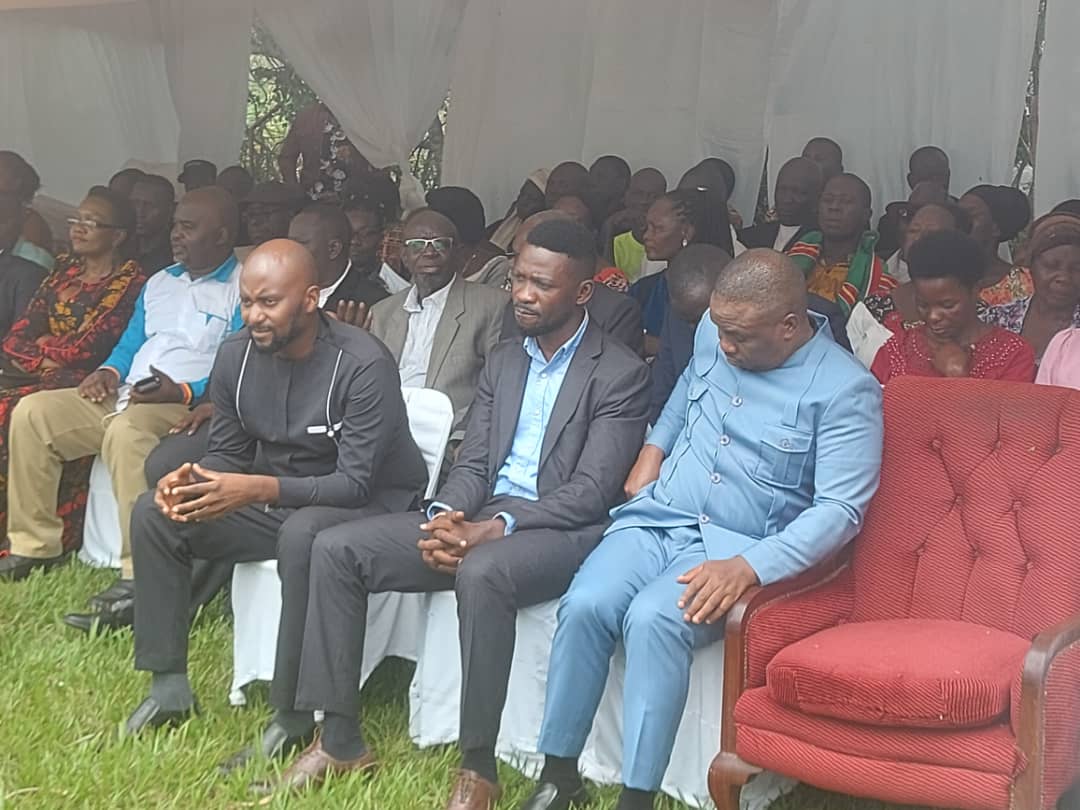
President Bobi attends burial of wife to ex LOP Oguttu
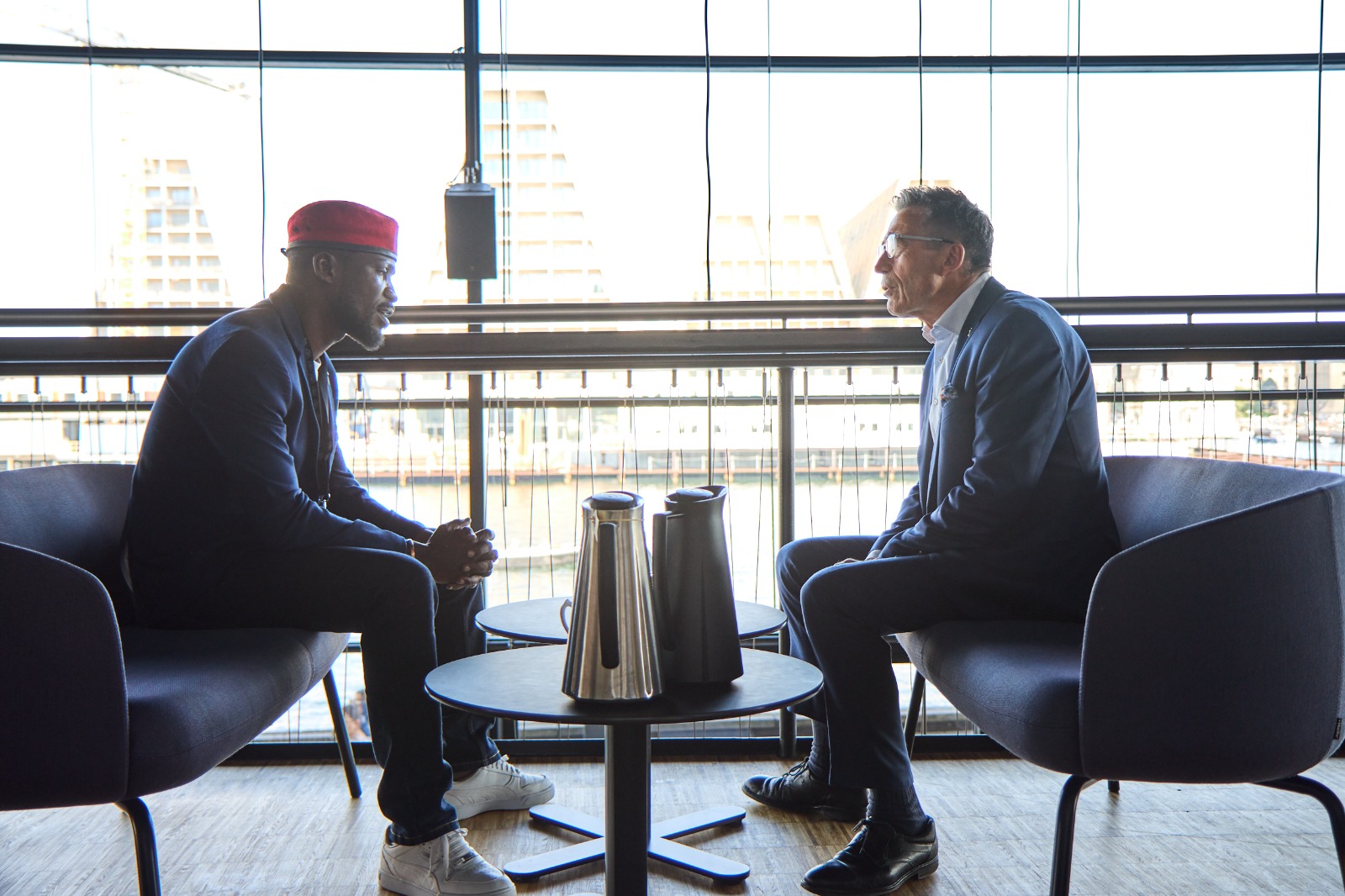
Bobi meets ex NATO boss, discuss key issues
EXCLUSIVE: A recap of Bobi Wine interview with BBS
This is why dictator M7 throws “Small victories” to the opposition
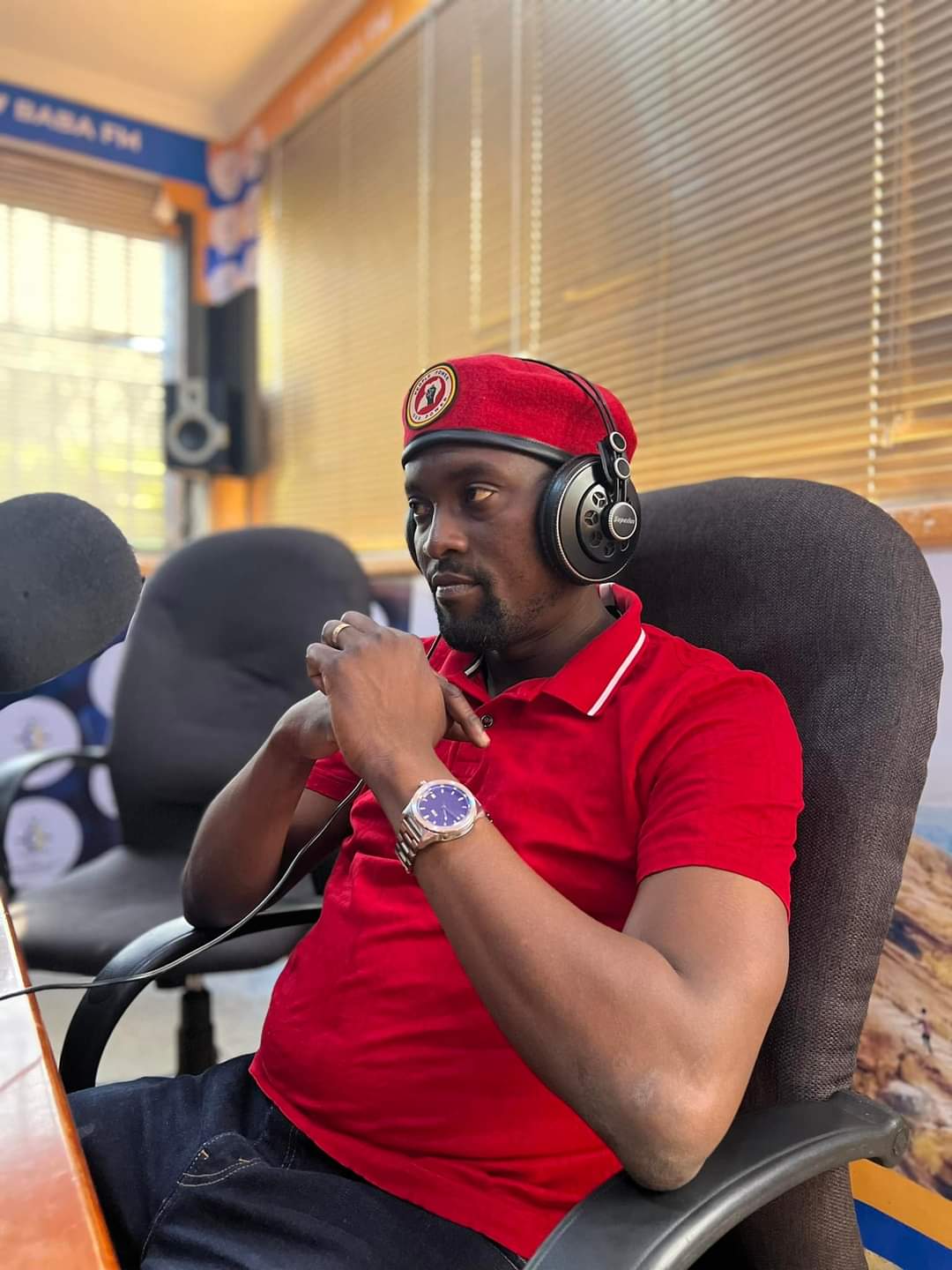
NUP Deputy Spokesperson Waiswa celebrates birthday in style
-
News3 years ago
President Bobi attends burial of wife to ex LOP Oguttu
-
News3 years ago
Bobi meets ex NATO boss, discuss key issues
-
News3 years ago
EXCLUSIVE: A recap of Bobi Wine interview with BBS
-
Uganda4 years ago
This is why dictator M7 throws “Small victories” to the opposition
-
Exclusive3 years ago
NUP Deputy Spokesperson Waiswa celebrates birthday in style
-
 Exclusive2 years ago
Bobi Wine The People’s President Full Documentary