
Exclusive
TERRENCE HOWARD DIRTY DEALS WITH UGANDA’S DICTATOR MUSEVENI EXPOSED.

ON THE HYPOCRISY OF TERRENCE HOWARD IN UGANDA
n
I have watched a sickening video of Terrence Howard, a BLACK American multiple award winning actor, as he pitched to Ugandan dictator Yoweri Museveni a new form of ‘flight technology’ that he purportedly ‘invented’, which he claims is going to “replace Drones, Helicopters, Aeroplanes,” etc.
n

n
n
n
Apparently, he cares so much about poor Ugandans that he is going to first implement his new technology here in Uganda; not in the USA whose government has billions of dollars guaranteed for inventors like him.
n
What Terrence Howard may not know is that Ugandans have seen Museveni hosting so many other shrewd peddlers of false hope before. We saw Kanye West (yes the one who said slavery was a choice), promising to build a Jurassic Park here.
nn
We saw musician Akon who came peddling ‘smart cities’ to be built in Uganda, when he has not built any in his homeland Senegal. All he needed was land. This means evicting poor Ugandans from their land to create a mile of land that Akon asked for.
nn
We saw ‘Prof.’ Safaraz Niazi who came in early 2020 peddling a Covid-19 “vaccine” for use in Uganda at a time when even the richest and most medically advanced countries on earth were still scratching their heads to find one. All he needed was money.
nn
Recently, we saw Pineti who went off with a huge chunk of land in Lubowa and over a trillion shillings. Now, we have Terrence Howard promising to take Uganda to the moon! He claims to have “all the resources necessary,” but that all he needs is a ‘fertile ground’.
nn
Whether legitimate or not, Mr Howard’s ‘scientific inventions’ are evidently just part of yet another grand scheme that dictator Museveni and the rest of his criminal enterprise have designed to once again take a huge bite out of Uganda’s resources while using the celebritie’s star power to legitimise the authoritarian regime. Terrence Howard is simply a hired gun participating in a game of con-artistry — and he knows it! If he was doing it in USA where strict and credible accountability is required for expending public resources, Mr. Howard would probably be a candidate for criminal prosecution — and he knows it!
nn
Mr. Howard is a BLACK MAN whose ancestors endured indignity, rape, murder, torture, enforced disappearances, economic disempowerment, and other evils that punctuated slavery and the era when racial segregation was at its peak. It is from this dark history that Mr. Howard rises among the very few black people who have been elevated to the most prominent and lucrative positions in society. He owes the black people every where on earth a duty to promote freedom and dignity. And yet here he is: coming to Uganda as an intellectual black-colonialist, peddling nothing but intellectual dishonesty! These are the people Malcom X called House Negroes.
nn
I cannot believe that in 2011, Terrence acted Nelson Mandela in a movie called WINNIE MANDELA. What an insult to Madiba?!
n
In that video, Mr Howard says that he has heard of Uganda for “most or my life”. I am sure before he came to Uganda, let alone wanting to do business here, he did some research and he is aware of the terror that Ugandans are enduring at the hands of Gen. Museveni. It goes without saying, therefore, that he is aware — but does not care — that dictator Museveni has for 36+ years subjected Ugandans to the same evils that Mandela fought. The same evils as Mr. Howard’s ancestors suffered at the hands of slave-masters and white supremacists.
nn
As I write this, in Karamoja region, Ugandans are dying of hunger while Gen. Museveni — a world renown tyrant and mass-murderer — spends a billion shillings everyday at home and his impulsive son spends some more on lavish birthday parties accross the country!
nn
Mr. Howard is not concerned about this oppression of his fellow black people in Uganda so long as he gets his share of the dictator’s loot! How different is he, then, from the House Negro?
n
Just like when Akon dined with the tyrant and said he doesnt care about democracy at a time when fellow artistes like Nubian Li, Dan Magic and others were in prison for following their conscience, Terrence Howard is colluding with dictator Museveni at a time when his fellow actors, writers, poets and creatives in general like Kakwenza, Wycliffe Luyombya and Mordecai Muriisa etc are in exile for siding with oppressed masses!
n
Freedom fighters like Patrice Lumumba and Kwame Nkrumah who are known for the same hairstyle as Mr. Howard spotted when he met Museveni are known for fighting oppression, not siding with the oppressor the way house negros would!
nn
If Terrence Howard really cares about Uganda, the last thing he should do is dine with a tyrant who has looted the country, undermined its democracy, terrorised its people and stagnated its development.
nn
I therefore want to put it to you Mr. Howard that Ugandans can do without your opportunism disguised as good will. You should be ashamed of yourself!
nn
Written by UGANDA’S Bobiwine.





Exclusive
More Than Politics: Understanding Bobi Wine’s Powerful Statement on Identity and Leadership
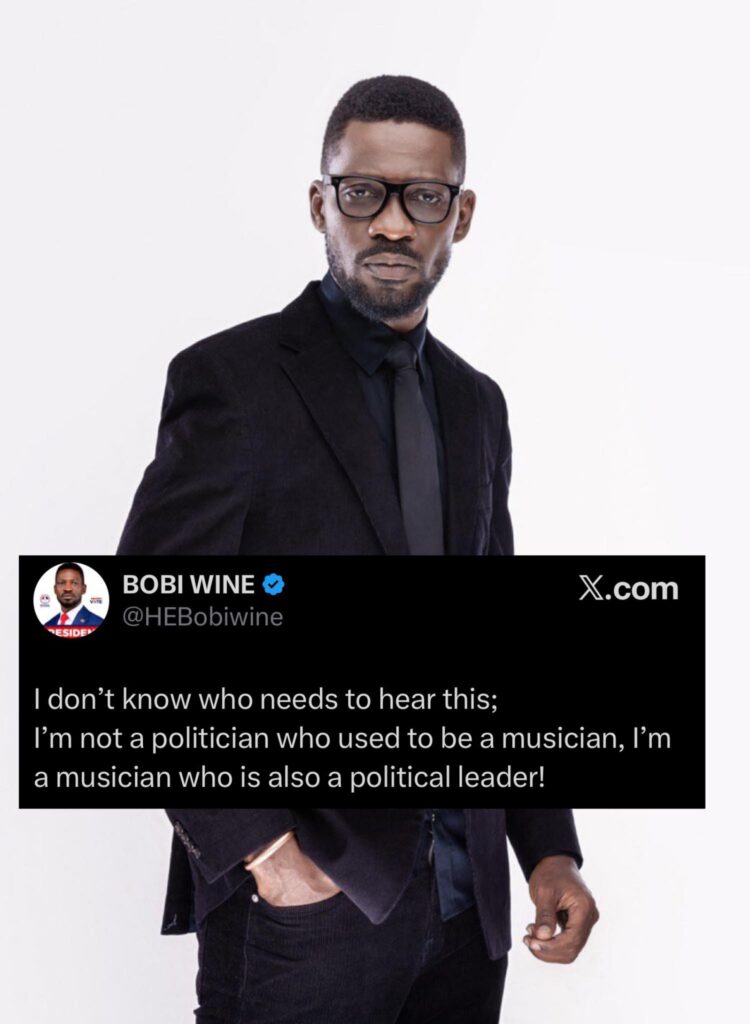
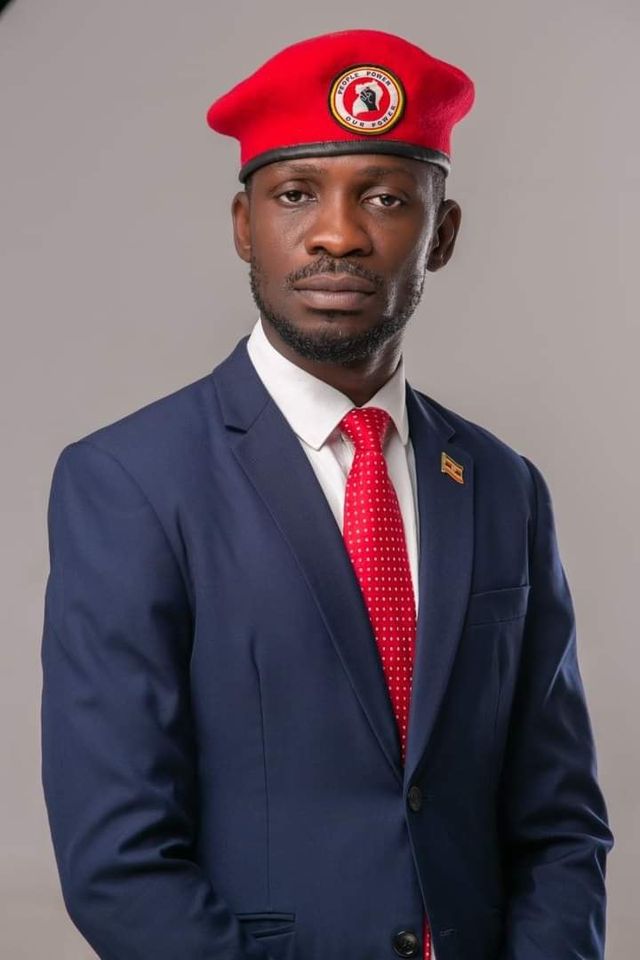
H.E Bobiwine on the 3rd of June 2026 posted on his X account “I don’t know who needs to hear this; I’m not a politician who used to be a musician, I’m a musician who is also a political leader,” This was much more than making a casual social media post. He reignited an important conversation about identity, leadership, and purpose.
In just a few words, H.E. Bobi Wine addressed a question that has followed him throughout his political journey: Is he a musician who ventured into politics, or a politician who left music behind?
His answer was clear, deliberate, and deeply significant.
A Statement About Identity
For many people, entering politics often means abandoning a previous profession and adopting a completely new identity. Businesspeople become politicians. Lawyers become politicians. Activists become politicians.
But Bobi Wine’s statement rejects this traditional thinking.
He is reminding the public that music is not merely something he used to do. It is not a chapter of his life that ended when he entered Parliament or became the leader of the National Unity Platform.
Music remains a fundamental part of who he is.
Before he stood on political platforms, he stood on concert stages. Before he addressed rallies, he addressed audiences through songs. Before he challenged government policies in speeches, he challenged social injustices through music.
His artistic identity did not disappear when he entered politics. Instead, it evolved into another form of public service.
In essence, Bobi Wine is saying that politics is something he does, but music is part of who he is.
His message is clear: leadership did not create him. Leadership emerged from the values, experiences, and convictions that were already present in the musician known as Bobi Wine.
Far from abandoning music for politics, he sees both roles as connected by a common purpose—to serve, inspire, and speak for the people.
That is why his statement is more than a tweet. It is a declaration of identity, a reminder of his roots, and a reaffirmation of the mission that has guided him throughout his public life.
Music Was Always About More Than Entertainment
Throughout his career, Bobi Wine used music as a tool to speak about social issues affecting ordinary Ugandans.
Many of his songs touched on themes such as poverty, unemployment, corruption, inequality, and the daily struggles of ordinary citizens. Long before he officially entered politics, he had already established himself as a voice for the marginalized and the forgotten.
This is why many of his supporters see his political career not as a sudden career change but as a continuation of the same mission.
The medium changed.
The message did not.
Where music once carried his voice, political leadership now provides another platform through which he communicates similar concerns.
Rejecting the “Just a Musician” Label
For years, critics have attempted to undermine Bobi Wine’s political credibility by referring to him primarily as a musician.
The implication is often that entertainers should remain in entertainment and leave leadership to traditional politicians.
This tweet appears to challenge that assumption directly.
By describing himself as “a musician who is also a political leader,” Bobi Wine is asserting that artistic achievement and political leadership are not mutually exclusive. He is rejecting the notion that one’s background determines one’s ability to lead.
History is filled with leaders whose influence began outside traditional political institutions. Some were teachers. Others were lawyers, military officers, religious leaders, writers, or activists.
Bobi Wine’s journey simply began through music.
Remaining Connected to His Roots
Another important message contained within this statement is the importance of remaining connected to one’s origins.
Political power often changes people. Positions, titles, and status can create distance between leaders and the communities from which they emerged.
Bobi Wine’s statement can be interpreted as a refusal to forget where he came from.
His music career connected him directly to ordinary citizens. Through concerts, lyrics, and public engagement, he experienced the hopes, frustrations, and aspirations of everyday Ugandans.
By continuing to identify himself as a musician, he signals that he remains connected to those roots despite occupying a prominent political position.
It is a declaration that leadership should not erase one’s history.
The Power of Authentic Leadership
At its core, this statement is about authenticity.
Many politicians spend years trying to craft an image that appeals to voters. Bobi Wine’s message suggests something different. Rather than reinventing himself, he presents his political leadership as an extension of the person he has always been.
The same individual who once inspired audiences through music now seeks to inspire them through leadership.
The same values that shaped his artistic work continue to shape his political vision.
The same voice that challenged injustice through song now challenges it through political action.
This continuity is what gives the statement its power.
His message resonates far beyond Uganda’s borders.
It speaks to anyone who has ever been told they must fit into a single category.
It challenges the idea that people should be defined by one profession, one title, or one chapter of their lives.
Human beings are multifaceted. They can be artists and leaders. Entrepreneurs and activists. Professionals and community servants.
Bobi Wine’s statement reminds us that growth does not require abandoning who we are. Sometimes, it simply means carrying our identity into new spaces and using it to serve a greater purpose.
Revolutionary Articles
Abducted Wife of Bobiwine’s Personal Assistant dumped at Police, Immediately remanded to Prison.



Disappearance, Denial, and Control: What Uganda’s Abduction Pattern Really Means
In Uganda today, repression no longer hides in the shadows—it operates in plain sight.
The case of Natabi Fauzia, also known as Maama Kyeyunevu, is not an isolated incident. It is part of a deeply troubling and increasingly normalized pattern—one that reveals how power is exercised, how fear is manufactured, and how the rule of law is systematically undermined.
The Abduction in Plain Sight
On March 12th, security forces reportedly raided a residence linked to associates of Bobi Wine, following heightened political tension after disputed elections and earlier military operations in Magere.
The target was clear. Authorities were searching for Bobi Wine.
They found neither him nor his personal assistant.
Instead, they took Natabi Fauzia, the wife of his personal assistant, Don Sheriff.
There was no warrant publicly presented. No formal charges announced. No explanation given.
She was taken.
And then—she vanished.
Denial in the Face of Evidence
In the days and weeks that followed, her family, lawyers, and activists demanded answers.
- Habeas corpus applications were filed
- Court sessions convened
- Public pressure intensified
Yet, state authorities consistently denied having her in custody.
This denial persisted despite reports of CCTV footage showing uniformed personnel carrying out the operation.
This is not just silence. It is institutional denial in the face of visible reality.
The Reappearance: From “Missing” to “Accused”
Then, more than a month later, on April 17th, the narrative abruptly changed.
Natabi Fauzia was dumped at Kanyanya Police Station.
From there, events moved with striking speed:
- She was immediately processed
- Taken to court without access to lawyers or family
- Charged under unclear and questionable circumstances
- Remanded to Luzira Prison
In a matter of hours, a person who officially “did not exist in custody” became a formal criminal defendant.
What Is the State Communicating?
This pattern—abduction, denial, reappearance, prosecution—is not accidental. It is deliberate. And it communicates several powerful messages.
1. “We Are Above the Law”
When a person is taken, denied, and later produced, the message is unmistakable:
The law does not bind those in power.
Courts may sit. Lawyers may argue. But ultimately, the state decides when the law applies—and when it does not.
2. Fear as a Tool of Governance
This is psychological warfare.
It tells every activist, every supporter, every citizen:
- You can be taken at any time
- You can disappear without trace
- No institution will immediately save you
The uncertainty is the weapon.
Not knowing where someone is, or what is being done to them, creates deeper fear than open arrest ever could.
3. The Collapse of Judicial Authority
Habeas corpus—the legal principle meant to protect against unlawful detention—becomes meaningless when the state simply denies custody.
What does it mean when:
- Courts demand accountability
- The state responds with denial
- And reality later contradicts that denial
It means the judiciary is being openly undermined.
4. Breaking the Individual Before the Trial
A month in incommunicado detention is not neutral.
It is a period of:
- Isolation
- Interrogation
- Intimidation
- Possible coercion
By the time the victim appears in court, the process has already achieved its primary goal: control.
The trial becomes a formality.
5. Rewriting the Narrative
The transition is calculated:
- From “abducted victim”
- To “criminal suspect”
By reintroducing the individual through the police and courts, the state attempts to legitimize what was initially illegal.
It reshapes public perception:
Maybe it wasn’t an abduction. Maybe it was lawful all along.
This is narrative control in action.
6. Testing the Limits of Resistance
Each case is also an experiment:
- Will the public protest loudly—or fall silent?
- Will the legal community push back—or retreat?
- Will the international community respond—or ignore?
If there is no consequence, the practice continues—and expands.
A Pattern, Not an Exception
Natabi Fauzia’s case echoes the experiences of countless others in Uganda—activists, opposition supporters, and ordinary citizens caught in the machinery of state power.
This is no longer about isolated abuses.
It is about a system.
A system that:
- Removes individuals outside the law
- Holds them in secrecy
- Reintroduces them under legal cover
- And uses the entire process to instill fear and assert dominance
Conclusion: The Meaning Behind the Method
What is happening is not disorder.
It is organized repression disguised as procedure.
It sends a chilling message to the nation:
- Your freedom is conditional
- Your rights are negotiable
- Your voice can make you a target
And perhaps most importantly:
The state is not just enforcing power—it is performing it.
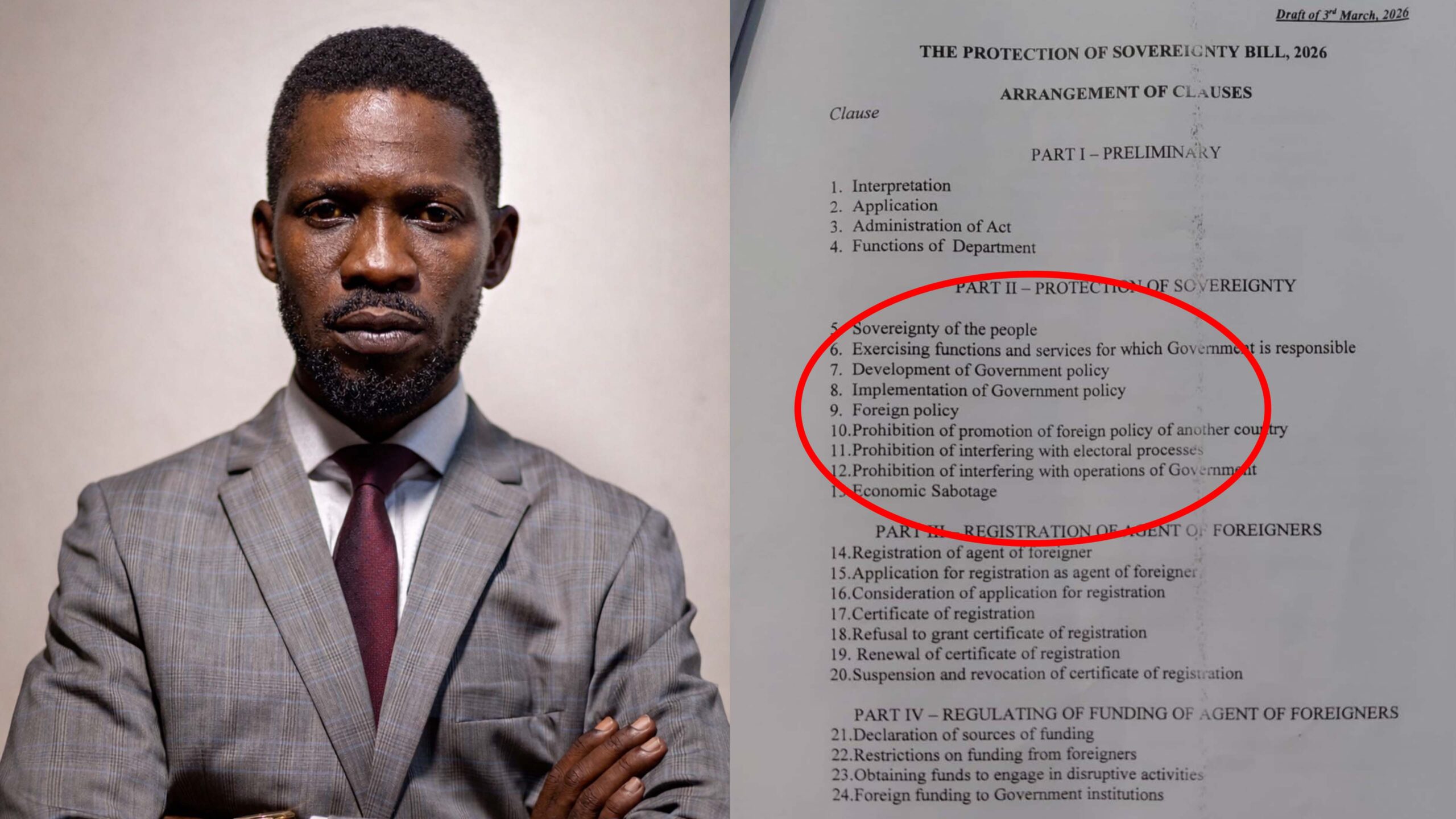
Ugandans are not strangers to laws introduced in the name of order and security—only for them to later restrict freedoms.
From the Public Order Management Act to sections of the Computer Misuse Act, history has shown a clear pattern: laws presented as protective tools have often been applied selectively—targeting opposition leaders, journalists, and ordinary citizens expressing dissent.
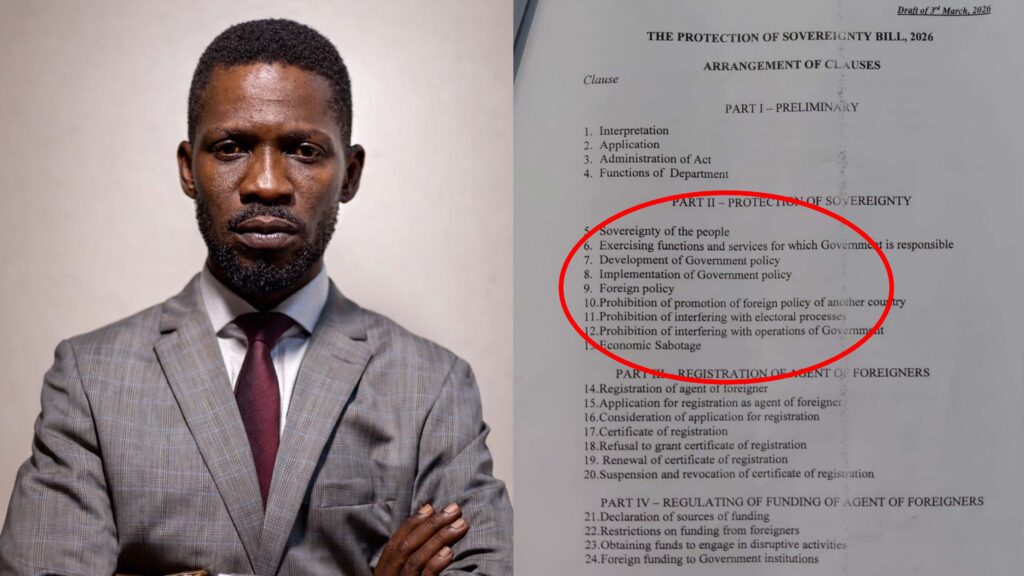
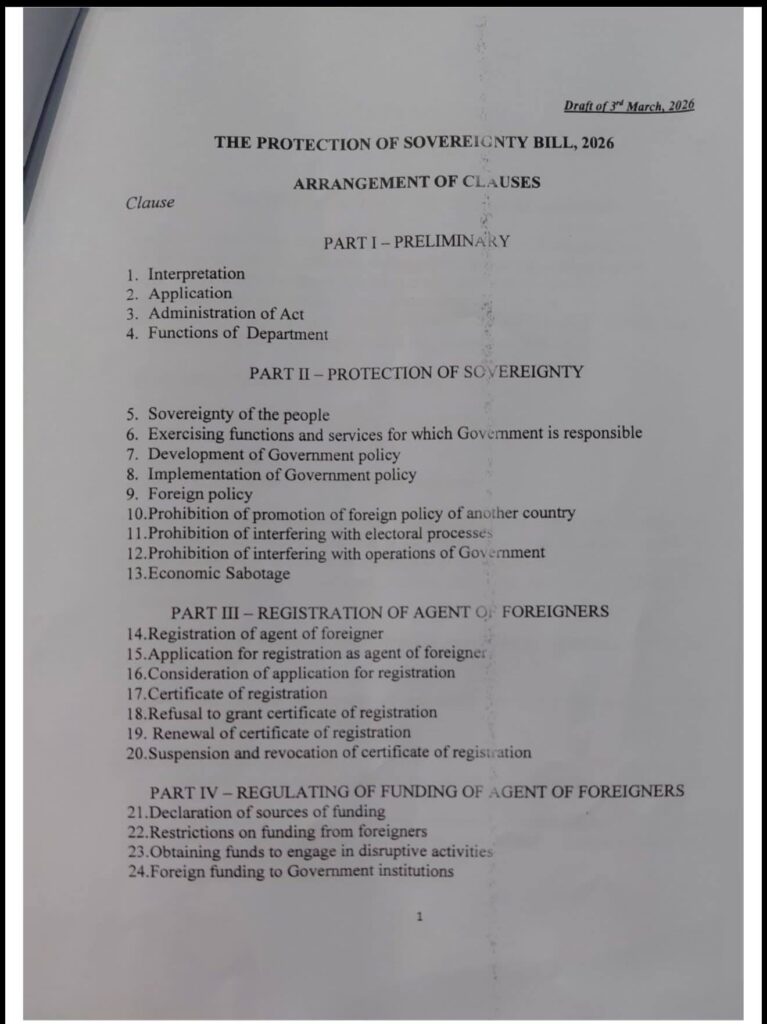
Now, the Protection of Sovereignty Bill, 2026 appears to follow that same path.
⚖️ The most dangerous laws don’t look dangerous
In politics, the most dangerous laws are rarely the ones that openly declare repression.
They are the ones that cloak control in the language of protection.
On paper, this bill promises to defend Uganda from foreign interference. It speaks of independence, dignity, and national control.
But beneath that language lies a deeper reality:
👉 Not a government protecting its people
👉 But a system protecting itself from its people
🔍 A quiet redefinition of sovereignty
Sovereignty, in its purest form, means power belongs to the citizens—it is the foundation of democracy.
But this bill subtly shifts that meaning.
Under its framework:
- Sovereignty becomes something the state must defend
- Not only from foreign actors
- But from any force that challenges authority
This shift is profound.
It blurs the line between:
- External interference
- Domestic dissent
👉 Criticism becomes destabilization
👉 Activism becomes foreign influence
And once that label is applied, suppression becomes not only justified—but legal.
💰 The real target: the lifeline of resistance
Modern civic movements do not survive on ideas alone.
They rely on resources—funding, partnerships, and networks.
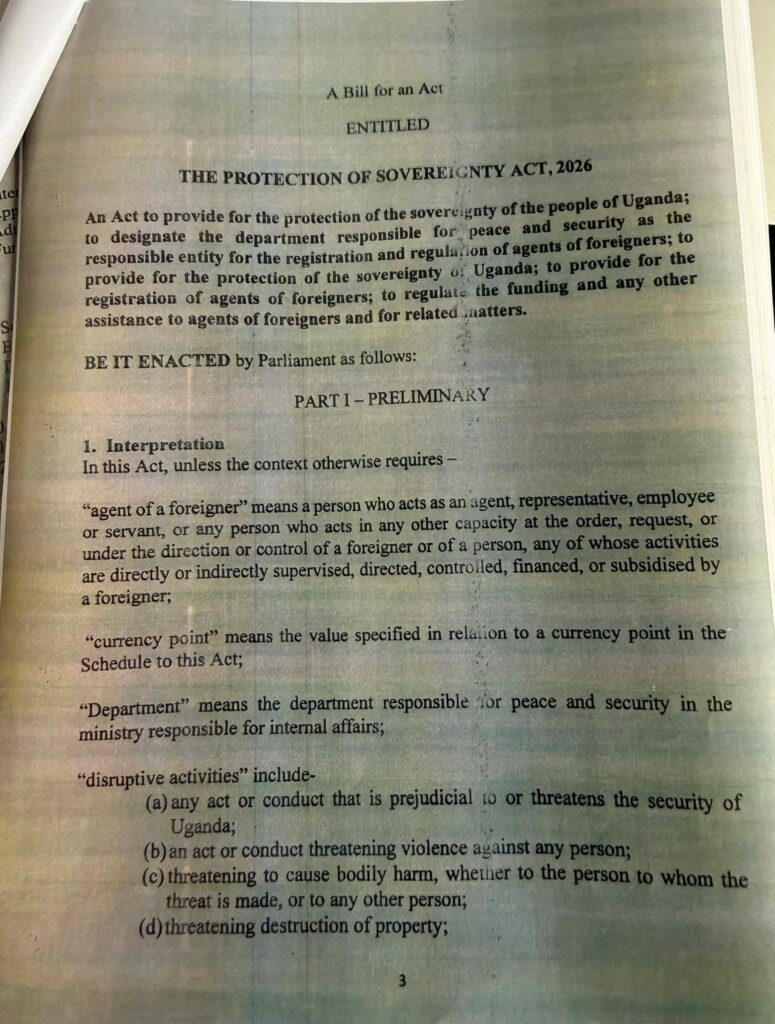
This is where the bill strikes with precision.
By:
- Requiring strict declaration of foreign funding
- Allowing monitoring and restriction of external support
- Granting the state power to block financial flows
👉 The law places the lifeline of civil society under control
It does not need to outlaw opposition.
It only needs to starve it.
Human rights organizations, independent media, and grassroots movements—many dependent on international support—could find themselves in a system where:
- Every transaction is suspect
- Every partnership is scrutinized
- Every initiative can be halted
This is not regulation.
👉 This is containment.
🔥 When activism becomes “foreign influence”
This is where the law directly intersects with Bobi Wine and the National Unity Platform.
For years, opposition movements and civic actors have:
- Engaged international media
- Spoken at global forums
- Met foreign policymakers
- Called for accountability and sanctions
- Partnered with international organizations
Under normal democratic practice, this is political advocacy.
But under this law, the same actions can be reframed as:
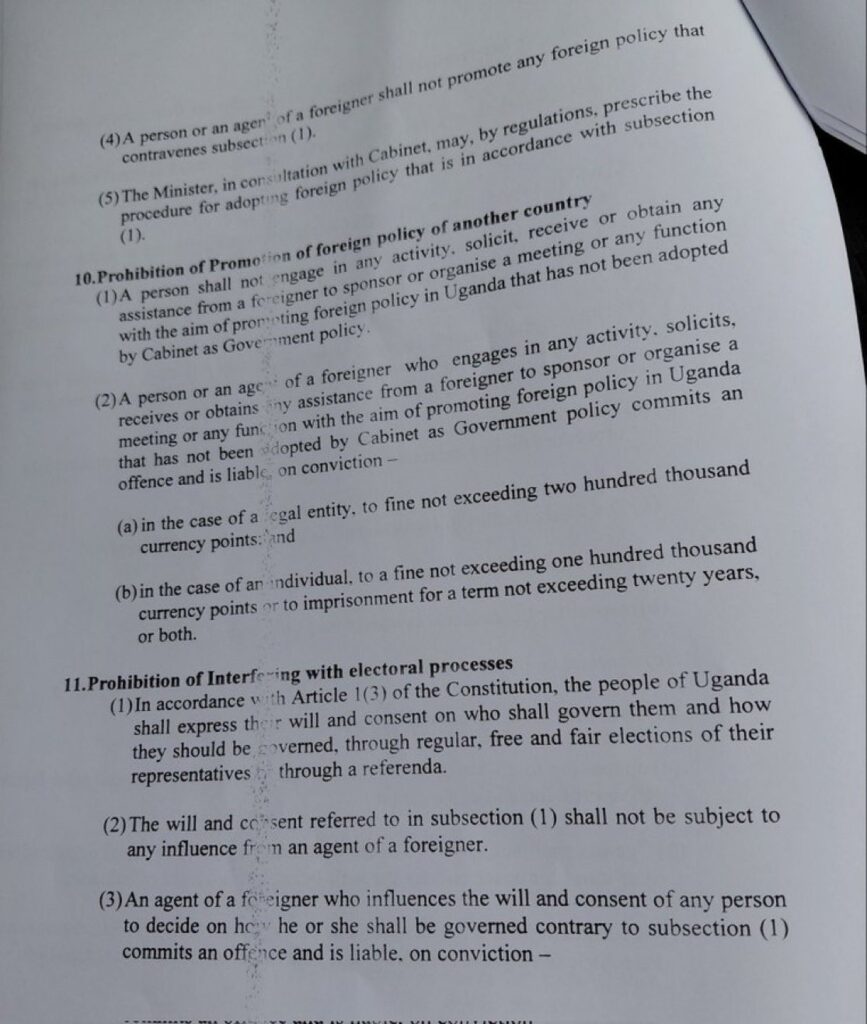
👉 Promoting foreign policy
👉 Receiving foreign assistance
👉 Influencing national processes
What has always been activism can now be redefined as criminal conduct.
🌍 The diaspora: from contributors to suspects
Perhaps the most striking implication is its impact on Ugandans abroad.
For years, the diaspora has:
- Supported families through remittances
- Invested in development
- Advocated for governance and human rights
But under this law:
- Calling for accountability
- Supporting opposition efforts
- Engaging international partners
👉 could be interpreted as interference in national affairs
The consequences are severe:
- Up to 20 years imprisonment
- Massive financial penalties
These are not just punishments.
👉 They are deterrents—designed to silence.
🚨 The deeper risk: criminalizing dissent
The most serious implication is clear:
👉 Activities traditionally considered democratic engagement
can now be labeled as crimes.
This includes:
- Public criticism of government
- International advocacy
- Political organizing
Once framed as “foreign influence,” such actions carry severe penalties.
This is how dissent is not debated—
👉 but criminalized.
💰“Economic sabotage” — a dangerous expansion
The inclusion of “economic sabotage” introduces another powerful tool.
In a country where citizens increasingly demand transparency:
- Questioning public spending
- Exposing misuse of funds
- Demanding accountability
👉 could be interpreted as harming the economy
This flips accountability on its head:
👉 Scrutiny becomes a crime
👉 Silence becomes safety
⚡ A shift in narrative power
Beyond the legal implications, this bill reshapes political perception.
It enables a narrative where:
- Opposition = foreign-backed
- Criticism = external interference
- Activism = threat to sovereignty
And once that narrative is accepted:
👉 Enforcement becomes easy
👉 Suppression becomes justified
Final reflection: What kind of nation is being built?
Laws do more than regulate behavior—they define the character of a nation.
And this law sends a clear message:
- Speak carefully
- Associate cautiously
- Engage at your own risk
That is not the foundation of a confident democracy.
It is the posture of control.
👉 When criticism is redefined as foreign interference, and activism becomes a crime, the question is no longer about sovereignty—it is about freedom.

More Than Politics: Understanding Bobi Wine’s Powerful Statement on Identity and Leadership

Abducted Wife of Bobiwine’s Personal Assistant dumped at Police, Immediately remanded to Prison.

🚨Uganda’s Protection of Sovereignty Bill would Jail Bobi Wine for 20 years.

Bobi Wine’s Washington Engagement: Institutional Significance and Policy Implications
Double Standards and Silent Complicity: Why Africa’s Dictators Still Thrive in a World That Claims to Defend Democracy
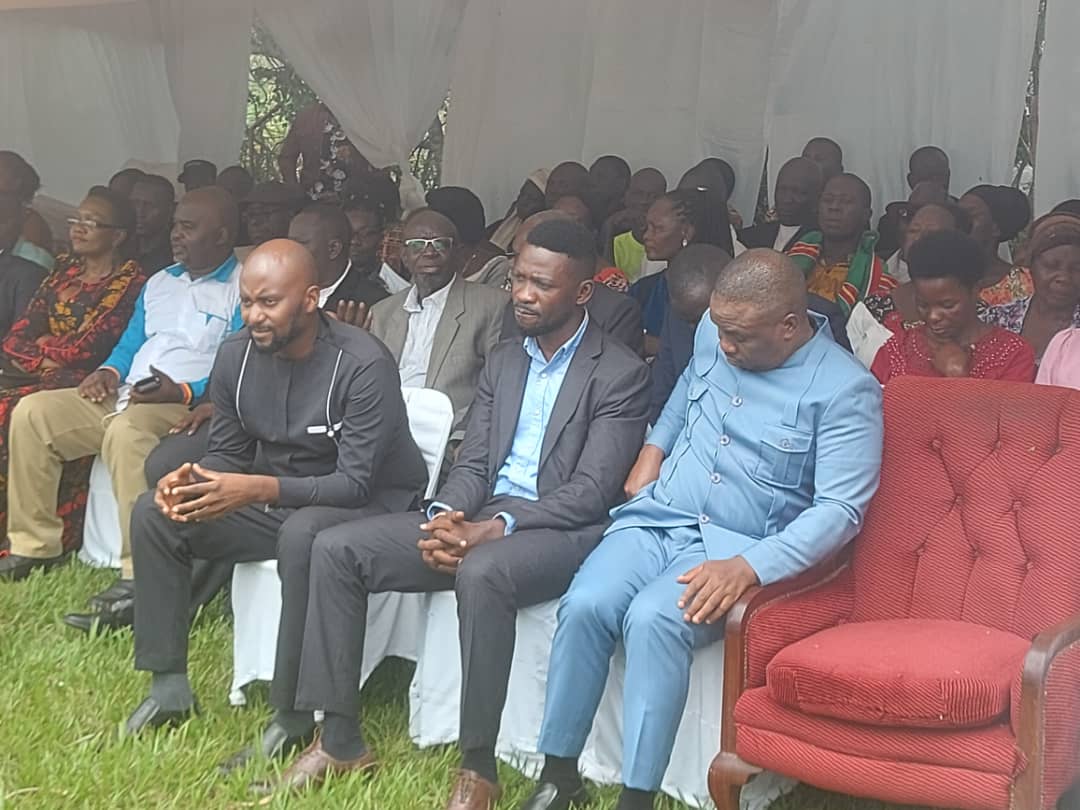
President Bobi attends burial of wife to ex LOP Oguttu

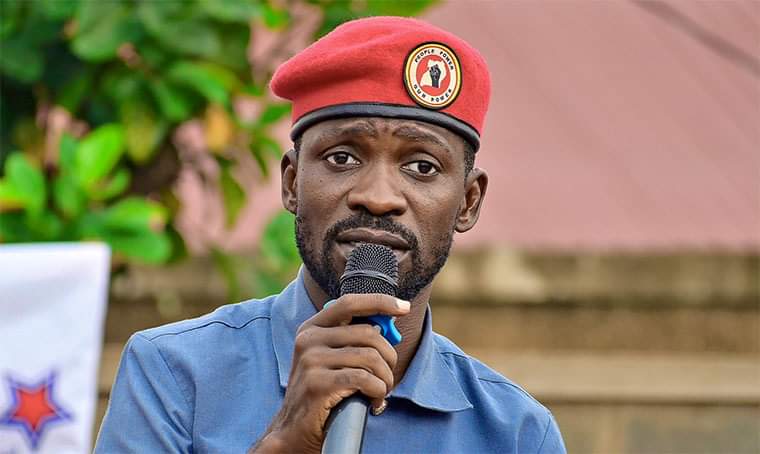
Bobi meets ex NATO boss, discuss key issues
EXCLUSIVE: A recap of Bobi Wine interview with BBS
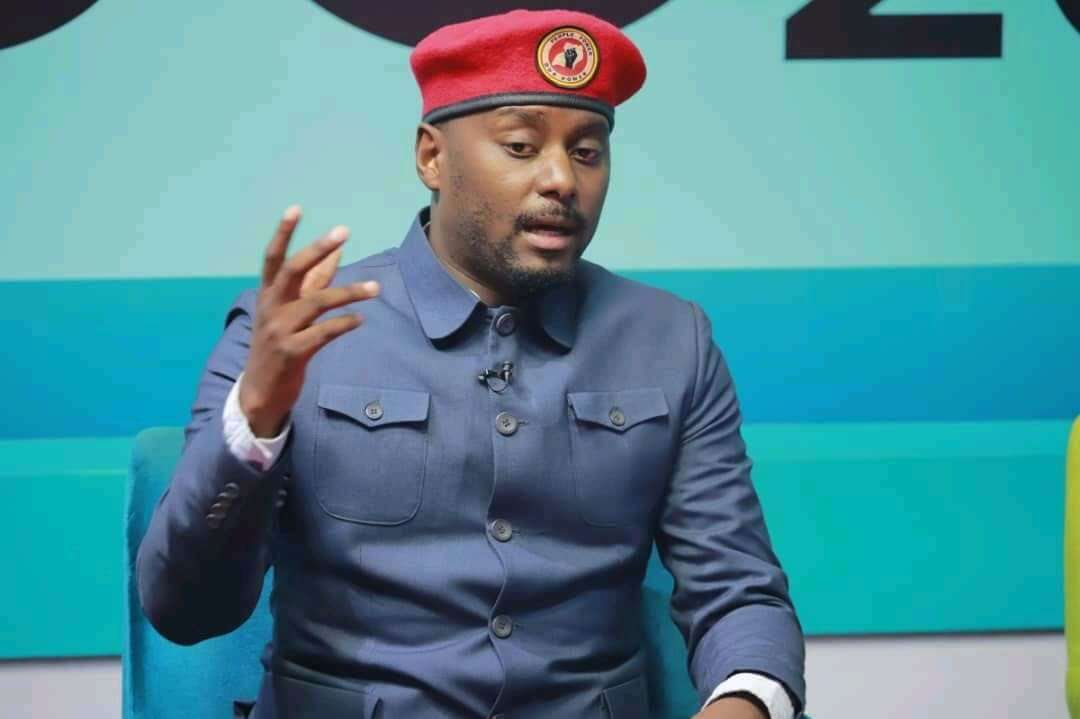
This is why dictator M7 throws “Small victories” to the opposition
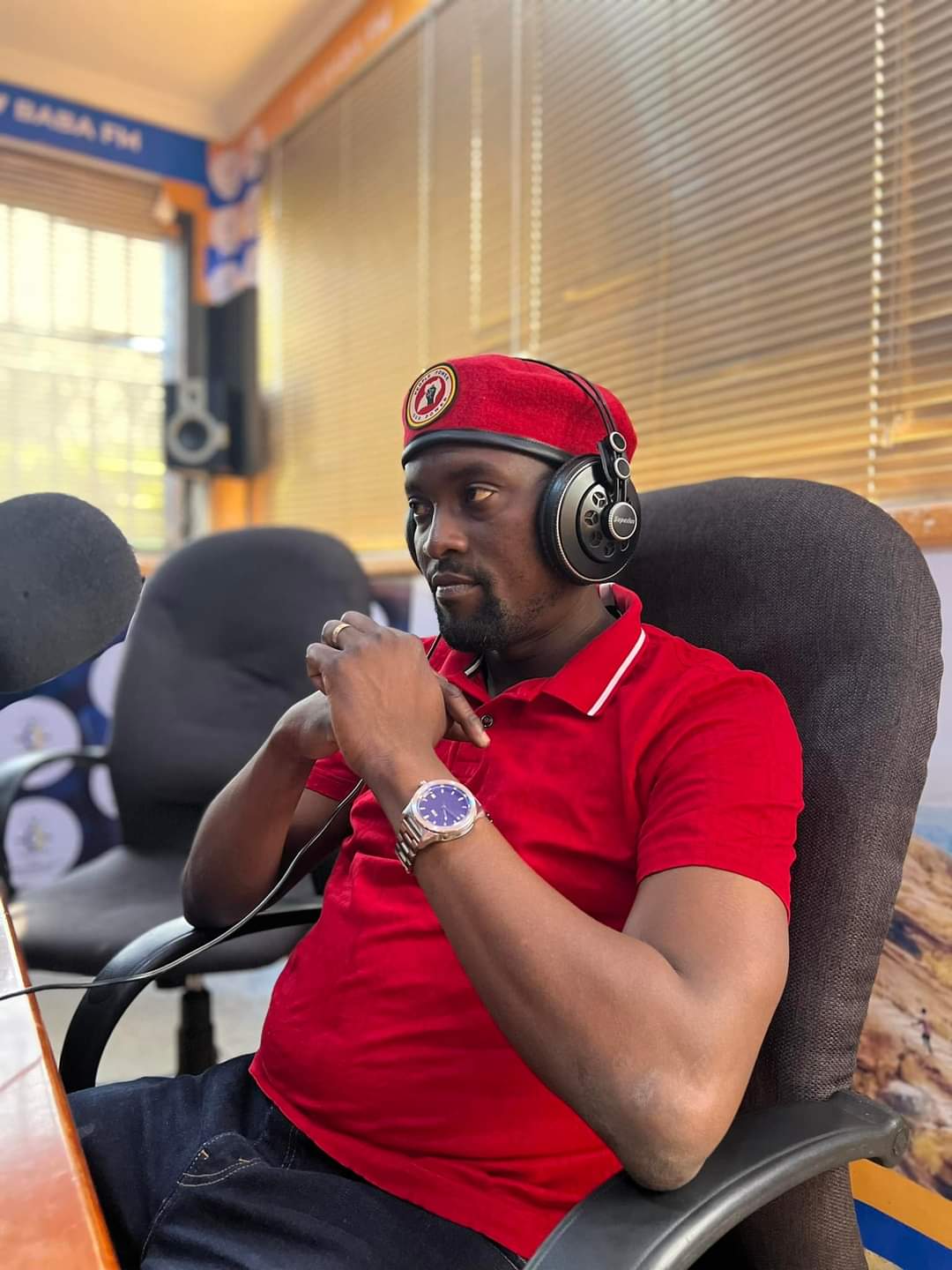
NUP Deputy Spokesperson Waiswa celebrates birthday in style
-
News3 years ago
President Bobi attends burial of wife to ex LOP Oguttu
-
News3 years ago
Bobi meets ex NATO boss, discuss key issues
-
News3 years ago
EXCLUSIVE: A recap of Bobi Wine interview with BBS
-
Uganda4 years ago
This is why dictator M7 throws “Small victories” to the opposition
-
Exclusive4 years ago
NUP Deputy Spokesperson Waiswa celebrates birthday in style
-
 Exclusive3 years ago
Bobi Wine The People’s President Full Documentary