Exclusive
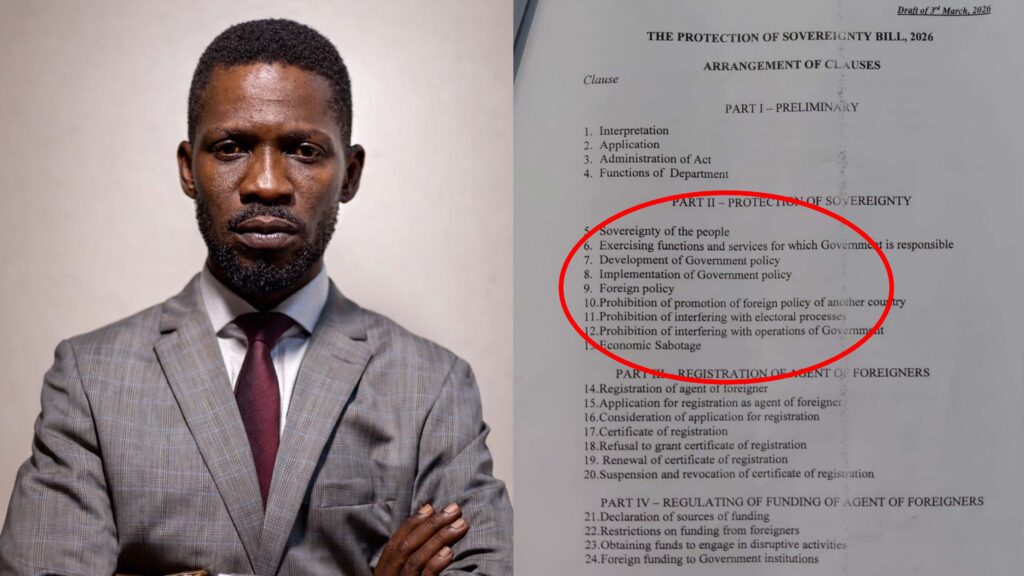
🚨Uganda’s Protection of Sovereignty Bill would Jail Bobi Wine for 20 years.
Ugandans are not strangers to laws introduced in the name of order and security—only for them to later restrict freedoms.
From the Public Order Management Act to sections of the Computer Misuse Act, history has shown a clear pattern: laws presented as protective tools have often been applied selectively—targeting opposition leaders, journalists, and ordinary citizens expressing dissent.
Now, the Protection of Sovereignty Bill, 2026 appears to follow that same path.

⚖️ The most dangerous laws don’t look dangerous
In politics, the most dangerous laws are rarely the ones that openly declare repression.
They are the ones that cloak control in the language of protection.
On paper, this bill promises to defend Uganda from foreign interference. It speaks of independence, dignity, and national control.
But beneath that language lies a deeper reality:
👉 Not a government protecting its people
👉 But a system protecting itself from its people

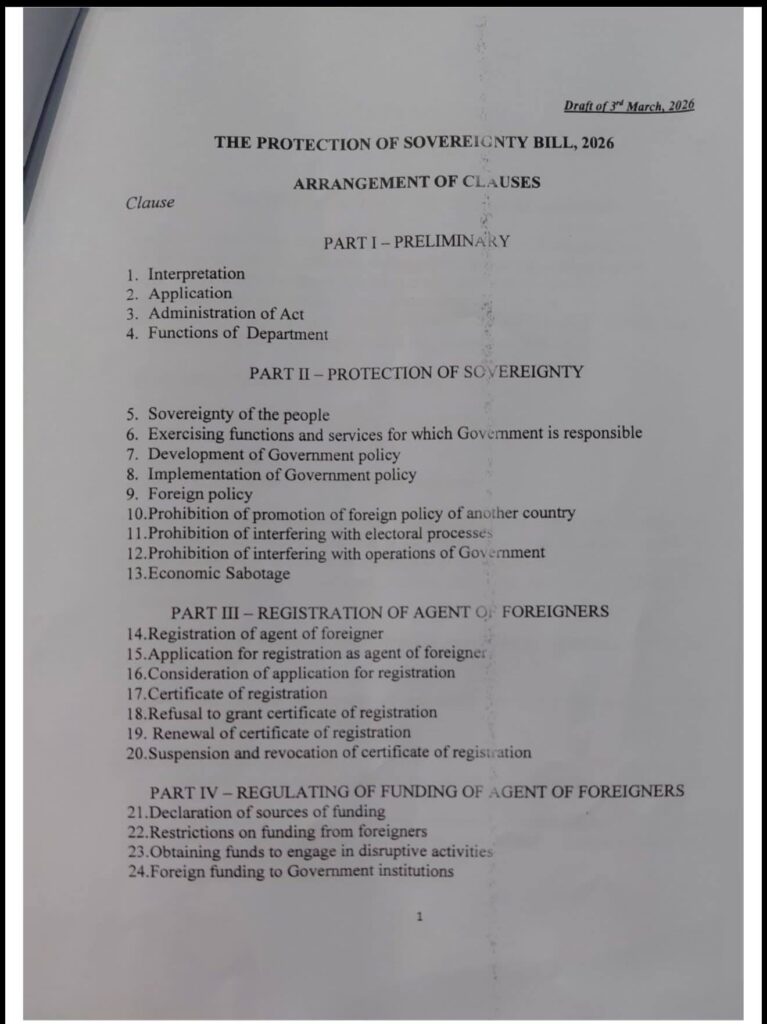
🔍 A quiet redefinition of sovereignty
Sovereignty, in its purest form, means power belongs to the citizens—it is the foundation of democracy.
But this bill subtly shifts that meaning.
Under its framework:
- Sovereignty becomes something the state must defend
- Not only from foreign actors
- But from any force that challenges authority
This shift is profound.
It blurs the line between:
- External interference
- Domestic dissent
👉 Criticism becomes destabilization
👉 Activism becomes foreign influence
And once that label is applied, suppression becomes not only justified—but legal.

💰 The real target: the lifeline of resistance
Modern civic movements do not survive on ideas alone.
They rely on resources—funding, partnerships, and networks.
This is where the bill strikes with precision.
By:
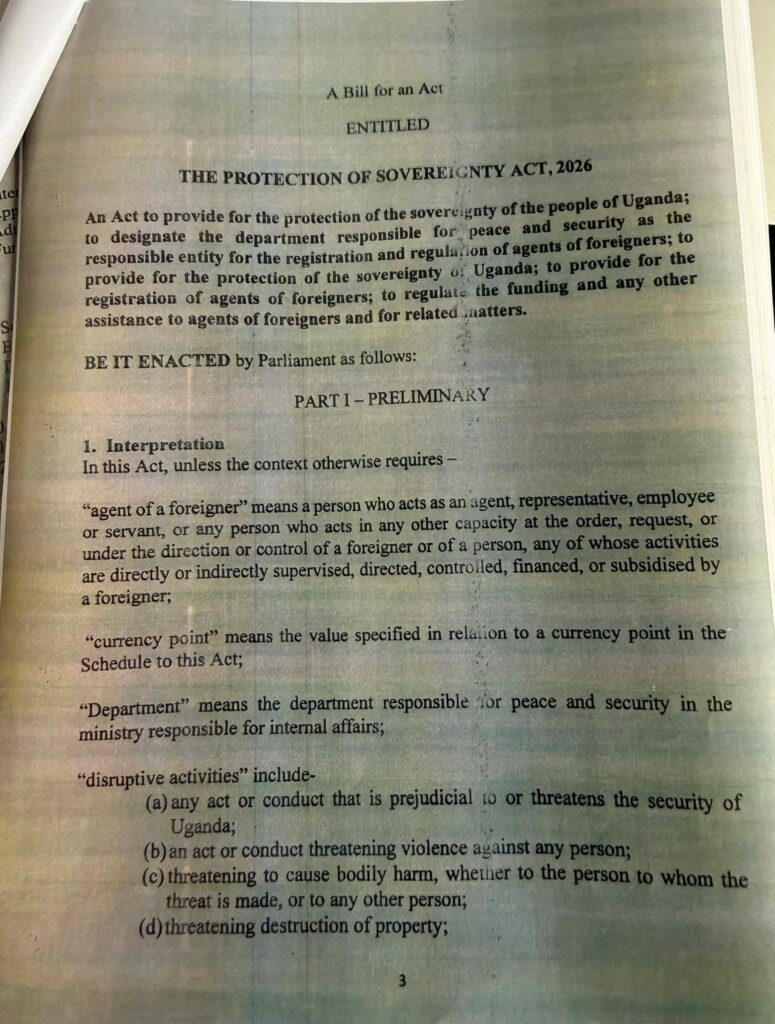
- Requiring strict declaration of foreign funding
- Allowing monitoring and restriction of external support
- Granting the state power to block financial flows
👉 The law places the lifeline of civil society under control
It does not need to outlaw opposition.
It only needs to starve it.
Human rights organizations, independent media, and grassroots movements—many dependent on international support—could find themselves in a system where:
- Every transaction is suspect
- Every partnership is scrutinized
- Every initiative can be halted
This is not regulation.
👉 This is containment.
🔥 When activism becomes “foreign influence”
This is where the law directly intersects with Bobi Wine and the National Unity Platform.
For years, opposition movements and civic actors have:
- Engaged international media
- Spoken at global forums
- Met foreign policymakers
- Called for accountability and sanctions
- Partnered with international organizations
Under normal democratic practice, this is political advocacy.
But under this law, the same actions can be reframed as:
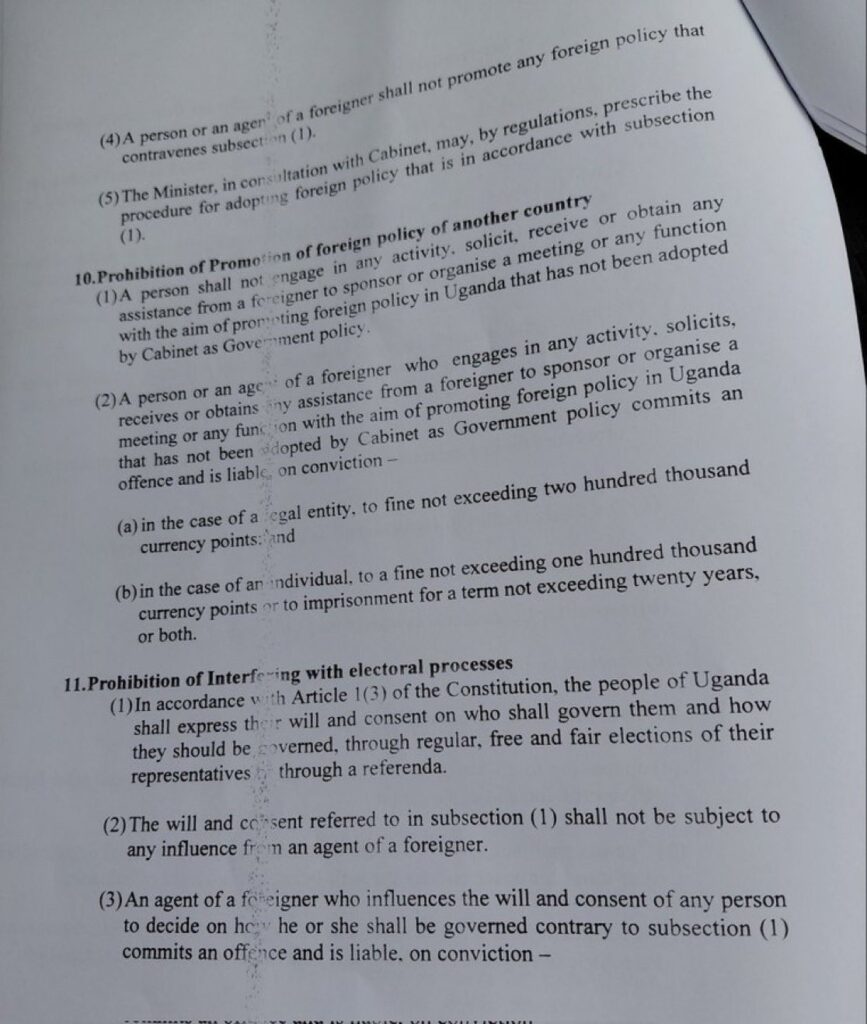
👉 Promoting foreign policy
👉 Receiving foreign assistance
👉 Influencing national processes
What has always been activism can now be redefined as criminal conduct.

🌍 The diaspora: from contributors to suspects
Perhaps the most striking implication is its impact on Ugandans abroad.
For years, the diaspora has:
- Supported families through remittances
- Invested in development
- Advocated for governance and human rights
But under this law:
- Calling for accountability
- Supporting opposition efforts
- Engaging international partners
👉 could be interpreted as interference in national affairs
The consequences are severe:
- Up to 20 years imprisonment
- Massive financial penalties
These are not just punishments.
👉 They are deterrents—designed to silence.
🚨 The deeper risk: criminalizing dissent
The most serious implication is clear:
👉 Activities traditionally considered democratic engagement
can now be labeled as crimes.
This includes:
- Public criticism of government
- International advocacy
- Political organizing
Once framed as “foreign influence,” such actions carry severe penalties.
This is how dissent is not debated—
👉 but criminalized.
💰“Economic sabotage” — a dangerous expansion
The inclusion of “economic sabotage” introduces another powerful tool.
In a country where citizens increasingly demand transparency:
- Questioning public spending
- Exposing misuse of funds
- Demanding accountability
👉 could be interpreted as harming the economy
This flips accountability on its head:
👉 Scrutiny becomes a crime
👉 Silence becomes safety
⚡ A shift in narrative power
Beyond the legal implications, this bill reshapes political perception.
It enables a narrative where:
- Opposition = foreign-backed
- Criticism = external interference
- Activism = threat to sovereignty
And once that narrative is accepted:
👉 Enforcement becomes easy
👉 Suppression becomes justified
Final reflection: What kind of nation is being built?
Laws do more than regulate behavior—they define the character of a nation.
And this law sends a clear message:
- Speak carefully
- Associate cautiously
- Engage at your own risk
That is not the foundation of a confident democracy.
It is the posture of control.
👉 When criticism is redefined as foreign interference, and activism becomes a crime, the question is no longer about sovereignty—it is about freedom.